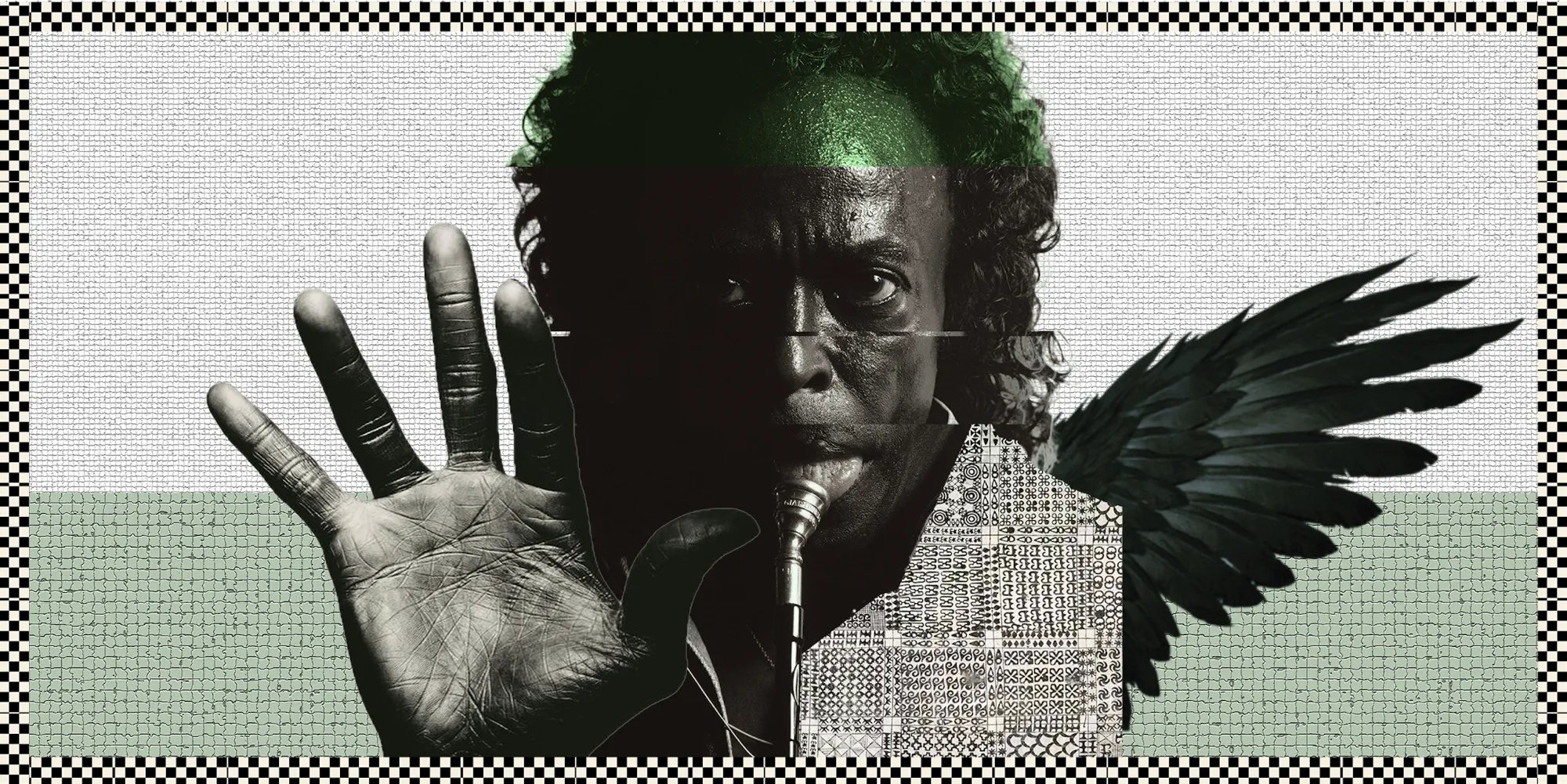
Hip hop taught Levi Robinson that a fragment of the past can build something present. Miles Hi is that idea applied to the man who kept reinventing jazz: a borrowed portrait, sliced, re-tinted and re-patterned until it belongs to a new author.
This soft pass reads the work the way a cultural property ledger would. It reviews Levi’s portfolio and sales record across three venues, scores Miles Hi across the five dimensions of the Cultural Property Rights Standard™ (CPRS™), models the commerce the work can move, and lays out the monetization lines that open once the work carries a registered record. It’s written for Levi Robinson.
Miles Davis, sampled in paint
The composition reads like a producer’s session. A checkerboard strip runs across the top edge. The crown of Davis’s head is lifted into green. The face is cut into horizontal bands that slip out of register, the way a sample slips against a new beat. A raised hand holds the foreground, a trumpet mouthpiece sits at the lips, and an Adinkra-style symbol grid fills the lower right, setting a West African visual vocabulary against an American icon.
Levi describes his aim as capturing what can’t be seen, and says the challenge is “what you choose to leave out.” Miles Hi leaves out most of the face and keeps the eyes, the mouth and the instrument. That editing is the authorship this record protects.
| Registry field | Value |
|---|---|
| Proposed ticker | $MILESHI |
| Title | Miles Hi |
| Originator | Levi Robinson (b. 1971, Newark, NJ) · HAUS OF LEVI, powered by House of Robinson Holdings, LLC |
| Subject | Miles Davis (1926–1991), trumpeter, bandleader, composer and painter |
| Form | Large original, mixed-media portrait collage |
| Medium · size · year | Not published on the listing. Day-0 fields. |
| Channel · status | levirobinson.net, Large Originals · Available |
| List price | $3,500.00 |
| Companion work | Frequent Flyer Miles · $3,500 · Available (shown with Miles Hi in the shop’s “Miles + Stones” image) |
| Underlying imageSource photograph | Unattributed on public record. See §09. |
| Sector · CDC | Fine Art, routed at Luxury 4.0× → CDC 1.20 |
Why the subject carries weight
Davis was himself a painter who heard music in line and color. A portrait collage of him by a hip hop–schooled artist is lineage-on-lineage: the sampler sampling the musician whose legacy, per his own biography, extends into hip hop.
A Culture Maker with receipts
Levi Robinson works in painting, collage, murals and installation, centering Black identity, memory and resistance. He studied at North Carolina Central University, moving from History to Graphic Design, and was shaped early by his uncle, Earl Jones. He names Charles White, Ernie Barnes, Gustav Klimt, Alphonse Mucha and Max Ernst as influences. He co-founded Ebon Altar, the Hue2 Foundation and Grail Arthouse, and is developing the Mary Fields Horse & Heritage Museum. On today’s call he described 15 to 20 years of serious practice and a holdings company and family trust already in place.
What the portfolio says. Levi sells, and he sells across channels: direct, a regional Black-owned gallery and an Artsy-listed gallery. His heritage-subject work converts: the Nina Simone edition sold out, and Overdue Recognition carries other Miles Davis portraits by him. Miles Hi sits inside a working jazz-icon line, not a one-off.
What it’s missing. Levi named it on the call: a paper trail. Thirty-two originals changed hands without a registered title, a valuation record or a resale term. Each sale was priced by the channel it sold through, and the same work can carry two tags. A standardized record gives him one figure to bring to every gallery and collector.
Thirty-two originals sold. Zero carry a record of what they were worth or a share of what they’ll resell for.MADE CX · Culture Market Data
BCPV 56.50, Tier 2 Commercial
This is a soft pass on public record: Levi’s HAUS OF LEVI site (About and Large Originals), his Overdue Recognition Art Gallery page, his Artsy page via TAAG Gallery, and Wikipedia’s Miles Davis entry, plus notes from the November 20, 2026 introduction call. “Sold” markers are listing status, not settlement records, and press and fair credits are self-reported. The confidence factor is 0.66.
| Dimension | Weight | Score | Contribution |
|---|---|---|---|
| CISCultural Influence | ×0.30 | 58 | 17.40 |
| CCIConsumer Conversion | ×0.25 | 46 | 11.50 |
| LIPLikeness & Identity · D3 flagged | ×0.20 | 66 | 13.20 |
| CUVCommercial Usage | ×0.15 | 40 | 6.00 |
| HLMHeritage & Lineage · 0–100 raw (≈2.5×) | ×0.10 | 84 | 8.40 |
| BCPV | Fine Art CDC 1.20 → index 67.80 | 56.50 | |
CIS 58. Levi’s footprint is real but regional: East Coast exhibitions, murals including a Black Lives Matter mural project covered by ABC 7, self-reported showings at Art Basel Miami Beach, Spectrum and Red Dot Miami, and a roster spot at Overdue Recognition beside Charles Bibbs and Paul Goodnight. The subject’s influence is universal. The work itself has no measured circulation yet, and his Artsy profile shows 13 followers, so CIS stays below 60.
CCI 46. Conversion evidence across the portfolio is strong for an emerging artist: 32 originals marked sold and a sold-out heritage edition. It is read conservatively. Sold markers are not settlement data, so a 30% realization discount applies, and Miles Hi itself has not sold.
LIP 66, the flagged dimension. Two identities are co-located in one object: Levi’s signature, the sliced-and-sampled collage method, and Davis’s likeness, one of the most photographed faces in music. That pairing lifts the score and raises the D3 flag in §07, because a deceased icon’s likeness and a living artist’s style can both be trained on.
CUV 40, the floor. No licensing history exists for the work: no edition, no image license, no product use. Levi’s giclée editions show a repeatable format exists, but CUV is held down until the underlying image source is documented (§09).
HLM 84. Heavy lineage on both sides: Davis, the 5× platinum Kind of Blue, the Hall of Fame and the national stamp; and Levi’s own line through Charles White and Ernie Barnes, hip hop sampling and the Adinkra vocabulary. It stops short of 90 because the subject’s custody chain belongs to the Davis estate, not to the originator.
Borrowed-heritage shape: HLM leads, CUV trails, conversion proven elsewhere
$MILESHI is heritage-heavy inside a sub-60 composite, the same shape as the $HALIM pilot, with one difference: much of the heritage is the subject’s. Calibration references: Gray 51.40 (Fine Art, Tier 2, $96K), My First Museum Photograph 62.80 (Fine Art, Tier 3), My First Sneaker Design 59.00 (Tier 2). Registration moves the weak dimensions first. A documented image source lifts CUV, and a recorded sale with a resale term lifts CCI.
$115K of property behind a $3,500 tag
TCPMV measures the commerce a cultural property can set in motion across its licensable lines. It is not a sale price, an appraisal or what a collector should pay for the canvas. The value-unit method below back-solves from the Framework’s Tier 2 band, positioned by Levi’s standing and adjusted for the subject’s heritage, so the figure is auditable.
| Step | Working | Result |
|---|---|---|
| Composite | 58×.30 + 46×.25 + 66×.20 + 40×.15 + 84×.10 | 56.50 |
| CDC | 0.75 × 0.40 × 4.0 (Fine Art routed at Luxury) | 1.20 |
| Index | 56.50 × 1.20 | 67.80 |
| Value unitCalibrated | Gray (index 61.68 → $96K) sets ~$1,556 per point for an emerging Fine Art record; Miles Hi is positioned modestly above for the subject’s heritage and Levi’s sales record | $1,700 |
| TCPMV | 67.80 × $1,700 = $115,260, published as a band | $115K |
The band runs from $75K to $260K and sits inside Tier 2 Commercial ($50K–$250K), with the top of the range touching Tier 3. It is placed at Tier 2, not rounded up. The gap between the $3,500 tag and the $115K property is the point: a one-time sale captures the canvas, while the record captures the lines in §05.
Five lines Miles Hi can license
Each line below turns the work into a recurring right instead of a single sale. Bands are modeled first-year ranges, not quotes. Together they come to $38K–$112K in the first year, before any AI line, against a $3,500 one-time sale today.
Sale with a MADE CX Art Buyer License
Sell the canvas with a registered title and a MADE CX Art Buyer License. The collector licenses the right to show its image for 5, 10 or 25 years at 10%, 20% or 40% of release value. Levi keeps copyright, prints and AI rights, receives a share of any resale while the license is in force, and every transfer is recorded on the work’s ledger.
Limited-edition giclée
An edition of 25 at Levi’s existing giclée range of $650–$1,250, each print carrying its own record. Modeled with a 30% realization discount because an edition is throughput until it sells.
Image & editorial licensing
License the image for jazz festivals, venues, publishers, programs and posters, priced per use and term instead of shared freely.
Apparel & merchandise capsule
A capsule built on the work and the Miles pair. The highest-volume line, and the one most dependent on clearing the subject’s likeness with the Davis estate first.
Exhibition, loan & education
Loan and program fees from jazz institutions, HBCU galleries and museums, building on Levi’s exhibition and education work.
AI & synthetic use
Not offered. Registered as a severable property so no training, style or likeness use reaches a default bundle. See §07.
How participation splits
Every line licensed through MADE CX settles on the 80/16/4 split. 80% goes to Levi as originator, about $30K–$90K on the first-year surface. 16% covers custody and enforcement. 4% goes to Community Return, about $1.5K–$4.5K, designated by CPRS™ across Health & Wellness, Culture Alignment, Entrepreneurship and Sustainable Communities and distributed by the CX Foundation on the culture property ledger.
The record has to come before the sale
A resale term can only attach at the first sale. Once a canvas leaves the studio without a record, its future transfers belong to whoever holds it. That is the cost hidden in Levi’s strong sell-through.
$84.3K at list, no resale term
- 19 large originals sold out at HAUS OF LEVI
- 17 originals marked sold at Overdue Recognition
- Nina Simone edition of 10, sold out
- Provenance can still be recorded, and a recorded sale history lifts every future record
$68.5K at list, all still registrable
- Miles Hi and Frequent Flyer Miles · $3,500 each
- Hatitude, Knot Baroque, Menstral Cycle · $12,500 each
- Zulu, Lean, Umber Ella · $6,500 each
- Dressaginistic · $4,500
The AI line comes first
Two identities in one image, both trainable
Miles Hi carries a deceased icon’s likeness and a living artist’s method. A model trained on Levi’s published work can produce “sliced jazz portrait collage” on demand, and the same model can generate new Davis likenesses in his style. Levi raised this himself on the call, pointing to an artist’s experience at the Black Boy Art Show.
Modeled at 2–5× TCPMV, the $MILESHI.AI surface is $230K–$575K. Registering it as a severable property, alongside a studio-level style record, keeps training and synthetic use out of any sale or license by default and gives Levi a dated, public record to enforce from.
- This week. Register $MILESHI and the severable $MILESHI.AI entry. Upload the work, title, medium, size and year.
- Before the next sale. Attach a MADE CX Art Buyer License to any original that leaves the studio, starting with the nine available works.
- Next 90 days. Document the underlying image source, then run a Day-0 pass to firm up CUV and open Lines B–E.
The first five to register
The first five works register at no cost. The recommendation is to spend all five on available originals, so each one carries a record and a resale term before it sells. The Miles pair leads; the three highest-listed works follow. Composites for works other than Miles Hi are scored at registration, not in this pass.
Each registration returns a property ID, ticker and record that Levi can place into House of Robinson Holdings and his family trust.
What has to be reviewed first
The source portrait and the subject’s likeness are undocumented
Levi’s practice works from found imagery, and Miles Hi is built on a photographic portrait of Davis whose source isn’t credited on public record. Davis died in 1991, and his will divided his estate among his heirs. This pass doesn’t determine what clearance any line needs. Levi’s attorney confirms the photograph’s source and terms and whether the estate’s consent is needed before Lines B, C and D are offered. The one-of-one original (Line A) is the cleanest line to register now.
Secondary gates: medium, size and year are not published, and the “sold” counts are listing status, not receipts. Each becomes a Day-0 field at registration.