An AI trend lifted Quavo and Takeoff out of their own “Hotel Lobby” performance and put everyone else in: presidents, chip CEOs, cats. The apps kept the flow, the movement, the orange room and the song. The Culture Makers were not credited. They were not paid.
This month, an ad for an AI photo editor put Migos' likeness, flow and aesthetic on a former President, a former First Lady and two of tech's top chip CEOs. It went viral. Then it became a template, and the template became a trend.11
The source is not a mystery. It is a two-minute-and-forty-six-second performance of “Hotel Lobby” that Quavo and his nephew Takeoff, performing as Unc & Phew, recorded for A COLORS SHOW in June 2022: a saturated orange room, a yellow riser, one microphone hanging from the ceiling, two men trading verses into it.2 In September 2026, AI apps began offering that performance as a fill-in-the-blank. Upload two photos. The software removes Quavo and Takeoff and keeps everything they made: the head-bobs, the mic trade, the lip-sync, the original audio, the room.1
By the end of the month, the lobby held Barack and Michelle Obama, Walter White and Jesse Pinkman, Spider-Man and the Green Goblin, Erling Haaland and Jude Bellingham, Taylor Swift and Travis Kelce, and two cats.13 It held everyone except the two men who built it.
This is the cleanest demonstration this series has had of what we mean by Cultural Use. It is not a fan tribute and it is not simply marketing. It is a commercial product built on the image, likeness, aesthetic, movement and music of Black Culture Makers, and it is being used to acquire users for technology companies. The song may be licensed. The likeness isn't. To the culture: $0.
Before it was a template, it was a record: a Black Music Month commission, made with Motown, produced by a crew COLORS says it hired as “a team of talented Black creatives.” Watch it once before you watch another copy.
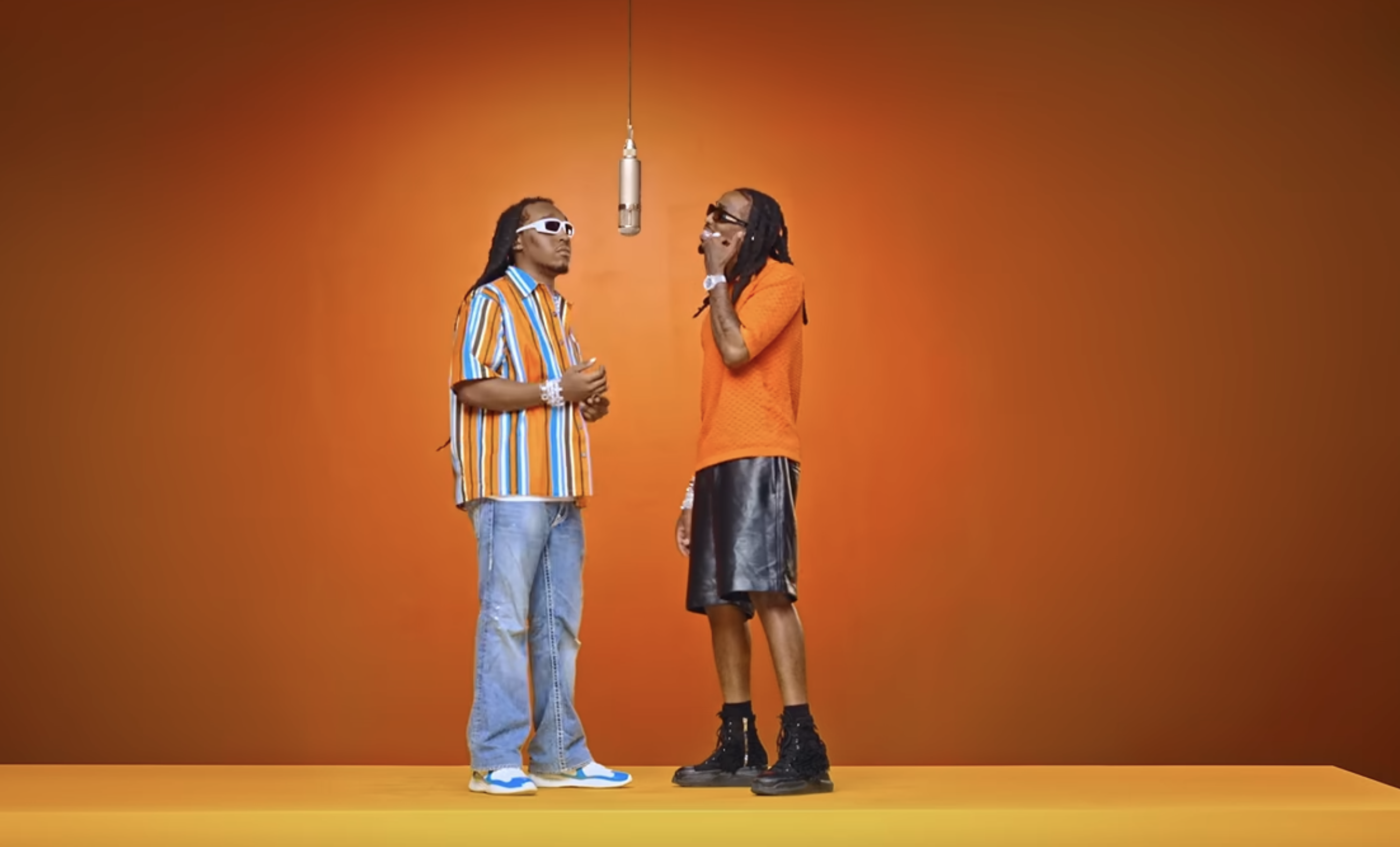
Watch the original
Read the credits block as a list of rightsholders, because that is what it is. Every name on it contributed something the AI templates now reproduce. The set designer's orange. The director's framing. The sound engineer's room tone under the original audio. The performers' faces, voices, timing and bodies. Media.io's product page describes what it sells as “the recognizable orange COLORS-style backdrop, hanging microphone, and coordinated rap movements.”4 That sentence is an inventory of other people's work.
A face-swap sounds like subtraction. The originals are removed. But look at what the trend actually keeps, and the math runs the other way.
The AI does not generate a performance. It borrows one. The apps' own marketing says so: they promise to preserve the original's “iconic head-bobs,” its “stage presence,” its lighting and room.4 Complex reports that the resulting videos “retain the rappers' movements, lip syncing and original audio.”1 Every element that made the clip worth copying is still there. Only the credit is gone.
| Element | Who made it | What the template keeps | Recorded to the makers |
|---|---|---|---|
| Likeness & identity | Quavo; Takeoff (now his estate) | Bodies, posture, hands, wardrobe silhouettes; faces replaced on top of theirs | NONE ON RECORD |
| Voice & flow | Quavo, Takeoff | The original vocal, with new faces lip-synced to it | NONE ON RECORD |
| Movement | Quavo, Takeoff | Head-bobs, the mic trade, the back-and-forth that makes it a two-person format | NONE ON RECORD |
| Aesthetic & set | COLORS; Munachi Osegbu; Rochelle Bennett; crew | The orange room, yellow riser, hanging mic, framing, light | NONE ON RECORD |
| Recording & composition | Unc & Phew; Murda Beatz, Keanu Beats, Fabio Aguilar; QC / Motown | The original audio, in full | NOT DISCLOSED |
Swipe to see the full table →
Elements and makers per COLORS and Complex. The last column is a MADE CX assessment of the public record: no credit, license or payment to the makers has been disclosed by any app named in this note. Absence in the public record is not proof of absence in private arrangements.
That table is the argument of this entire series in five rows. Music licensing, where it happens, covers one row. The other four have no instrument. There is no standard license for an aesthetic, no registry for a movement, no default clearance for a posthumous likeness when it is used as the skeleton for someone else's face. So those four rows get treated as free. Not because they have no value, but because nobody recorded a title.
A face-swap does not remove the Culture Maker. It removes the credit and keeps the work.
Founder's Note No. 12Viral templates are how consumer AI apps acquire users. “Hotel Lobby” is not a byproduct of these products. It is their ad, their onboarding flow and their conversion event.
Follow the path a user takes. A viral clip appears in the feed. The caption says where it was made; one popular version told viewers to “Comment ‘Glorify’ for the link to make this in one click.”3 The link lands on a product page with the rappers' names in the title. The page offers free credits on signup. Then it offers a subscription.
At Media.io the page is titled “Migos AI Trend Video | Create the Viral Quavo & Takeoff Hotel Lobby AI Video.” The banner above it reads “First Subscription up to 50% OFF.” Below the generator sits a gallery of user submissions, each one a fresh copy, each with a “Go Create” button.4 XXL reports that Starrd charges $5 per 15-second video.5 Other editors, LightX among them, publish step-by-step guides to making the video “with an AI tool (like LightX).”6
The AI photo editor ad that started our reel this week understood the assignment better than any of these pages. It did not need to explain the format. It put a former President, a former First Lady and two of the most powerful executives in semiconductors into the orange room and let recognition do the selling.11 The recognition it was spending belonged to Quavo and Takeoff. Their culture was the ad's working capital, and it was drawn down without a term sheet.
Call it what it is on a balance sheet. The apps are booking user growth, trial starts and subscription revenue. The input that produced that growth carries no cost basis, because nobody sent an invoice, and nobody sent an invoice because there was no instrument to send one under.
Coverage of the trend has mostly been explainers: where it came from, which apps make it, how to join in. The word most outlets reached for was “harmless.”5
Joe Budden is one of the few voices with a microphone who has refused that framing and named it as extraction. A clip of his reaction circulating on TikTok carries the headline: “Joe Budden REACTS To The Viral Ai Migos ‘Hotel Lobby’ TREND That Is Using DIGITAL Blackface To Gain Popularity.”10 Digital blackface is the right term of art. It describes non-Black users and brands wearing Black expression, voice and gesture as a costume for attention. Here the costume is a specific performance by two specific men, and the attention is being monetized by companies that had nothing to do with making it.
Fans said it in plainer words. “It's upsetting that people decided to turn this into an Ai meme,” one wrote, “but even more disturbing that Takeoff is dead and even with that considered, y'all still circulated the erasure of that man for some dancing cartoon characters.”1 Erasure is precise. The trend does not mock Takeoff. It deletes him and keeps what he did. HotNewHipHop's Alexander Cole called the edits “AI slop” that “cheapens” the original by divorcing it from its source.7
Quavo answered the only way the system currently lets him: by pointing. “Aye Take we viral again,” he wrote, reposting the untouched performance. “The original!!!”1 It is a gracious response and a telling one. The man whose likeness is powering a trend has one tool available: a repost. He can remind the internet who made it. He cannot send it a bill.
“Aye Take we viral again. The original!!!” is a claim of title made in the only language the market has given him.
Founder's Note No. 12 · on Quavo's post of 23 September 2026This series has made three claims. The “Hotel Lobby” trend proves all three in one clip.
One: culture is property. If it were not, no one would build a product page around it. Media.io did not write “Join 500,000+ Users Making Viral Migos AI Trend Videos” about a generic dance. It wrote it about a named performance by named artists in a named room, because the names are the value.4 Things with value that can be named, used, sold against and excluded from are property. The only thing missing is the record.
Two: culture is an unrecognized asset class that drives the economy. Follow the money one more step. The performance drove streams for the label, views for COLORS, and now user acquisition and subscription revenue for a class of AI companies that did not exist when it was filmed. The same asset is being drawn on by three industries. It appears on none of their balance sheets as an input, and on none of its makers' balance sheets as an asset. That is what “unrecognized” means in practice: the value is real, it moves, and nobody who made it holds a claim on the flow.
Three: the value is intergenerational. Takeoff died in November 2022. Four years later, the performance he gave with his uncle is more commercially active than on the day it was released. It is powering a new category of software, reaching an audience that may never have heard the song, and generating revenue for companies he never met. The asset did not stop when the maker did. It appreciated.
That is the heart of it. Unc & Phew was a family name for a family act: an uncle and a nephew. The right to that performance now sits partly with an estate. The value it generates today, and whatever it generates when the next AI format arrives, should flow back into that family and the community that shaped them. Without a title, it flows everywhere else.
Influence at the top of the scale, documented uncompensated commercial use, and a posthumous likeness in active synthetic reuse.
Under the Cultural Property Rights Standard, virality and remix rate raise the Cultural Influence Score. Documented uncompensated use raises Commercial Usage Value, because it is evidence of demand. A posthumous likeness in AI reuse raises the Likeness & Identity Premium and triggers the standard's lead urgency flag for synthetic exposure. The uncle–nephew lineage is read under the Heritage & Lineage Multiplier. This is a description of what moves the rating, not a rating: CPRS scores are set only on registration, with the claimants.
The Cultural Property Rights Standard was built for exactly this failure: an asset with clear originators, a documented first performance, massive commercial reuse, and no title layer connecting them. CPRS does not replace copyright or the right of publicity. It adds the record those regimes lack, a registry entry that names the holders, appraises the asset, and sets terms for each kind of use. MADE CX is the registry and the exchange that make those records usable. Here is how it applies to “Hotel Lobby.”
Quavo can repost “The Original.” CPRS lets him, and Takeoff's estate, invoice for it.
MADE CX invites Quavo, the estate of Kirsnick Ball, COLORS and the “Hotel Lobby” crew to register the performance on the made.cx registry as a titled cultural asset, with a severable AI sub-property, so that the next app to build a funnel on it signs a license first.
Every culture that has ever been copied had its version of this moment. What is new is the speed and the scale. A single performance by an uncle and his nephew can now be turned into a software feature in weeks, sold on subscription, and distributed to millions of people who will never see the original. The copying used to take years. Now it takes a template.
The answer is not to stop the trend. Culture travels; that is how it becomes valuable. The answer is to make sure that when it travels, the title travels with it. Every copy should carry the originators' names. Every commercial use should carry a license. Every license should pay the people who made the thing, and keep paying their families after they are gone.
Takeoff is not here to see what his performance is worth now. His family is. The least this industry owes them is a record that says whose it is.
Yours in the interest of the race,
Artists, estates and creative crews: register your performances, your likeness and your aesthetic before the next template does it for you. Each Founder's Note lands in your inbox first.
Reported facts are cited to their source. Company marketing claims are labeled as claims. Where a statement is a MADE CX assessment rather than a reported fact, it is labeled as such.
MADE CX publishes editorial research and commentary on cultural property and commerce. Nothing on this site is an offer to sell or a solicitation of an offer to buy any security or interest, and nothing here is investment, legal, accounting, or tax advice.
Designations shown with a dollar sign — for example $CULTURE — are editorial identifiers used to name the subject of an analysis. They are not securities, digital assets, tokens, funds, or tradeable instruments of any kind, and no such instrument is offered or available.
Names, marks, and images of individuals, estates, and organizations appear for purposes of news reporting, commentary, and analysis. Their appearance does not imply affiliation with, sponsorship by, or endorsement of MADE CX.
© 2026 MADE CX. MADE CX, CPRS, and Culture Exchange Standard are trademarks of MADE CX. All other marks belong to their respective owners. Corrections and rights inquiries: hi@madecx.info.