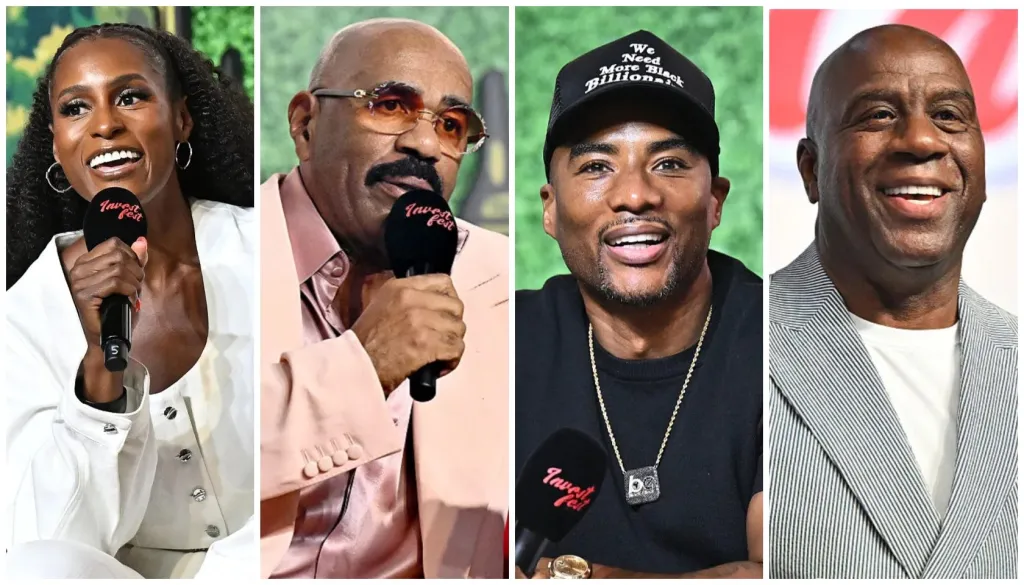
Every August, roughly thirty thousand people walk into the Georgia World Congress Center to learn how
to build wealth. The sharpest criticism of Invest Fest is that the clearest example of wealth creation on display is
the event itself. That criticism contains the whole thesis of this report. It just draws the wrong conclusion from it.
This report does four things. It puts a number on the cultural property underneath Invest Fest. It explains why the
festival keeps getting measured against finance conferences it doesn't resemble. It answers the extraction critique
with arithmetic rather than sentiment. And it shows how an event registered as cultural property, a
$CULTURE asset, routes a share of its value back to the community it draws from, by structure rather
than by goodwill.
Why this file exists
Invest Fest isn't overpriced or underpriced. It was never measured.
Nothing here argues that Earn Your Leisure has done anything other than build an extraordinary business. Rashad Bilal
and Troy Millings took a podcast to a Main Stage that drew Serena Williams, Magic Johnson, Steve Harvey and Jack
Dorsey in a single weekend. The point is narrower and more structural. A festival that mints new cultural property
every year is being valued, and criticized, as if it only sells tickets. That is the gap the Cultural Property Rights
Standard™ closes, and the reason this file is published as education rather than critique.
01 — The Event
A podcast that became the biggest wealth festival on the calendar
Earn Your Leisure started as a conversation between a former elementary school teacher and a former financial
advisor about the money lessons most people were never taught. It became a media network: a Top 20 business podcast
with more than 50 million downloads, 1.68 million YouTube subscribers across 3,900 videos, 1.6 million Instagram
followers, EYL University, two books and a live tour that has played The Theater at Madison Square Garden. Invest Fest
is where all of it meets in one room.
2021
Invest Fest settles in Atlanta. The festival begins its run in the city; 2026 is its sixth consecutive year there, per the Atlanta Journal-Constitution.
Nov 2022
Invest Fest Euro sells out in London. The format travels. CAA's speaker profile lists a London edition at the Royal Albert Hall.
2022–2024
City Hall leans in. Mayor Andre Dickens speaks at the 2022 festival and in 2024 announces that year's dates at a City Hall news conference.
Jul 2026
The host-city question goes public. The founders say promised city support never materialized and that they're open to moving. The mayor's office says it didn't proactively reach out; the convention bureau notes Atlanta hosts 700+ meetings a year.
Aug 7–9, 2026
Invest Fest 2026. Georgia World Congress Center. Serena Williams becomes the first woman to headline. About 400 vendors, an Open Pitch competition with a $125,000 investment prize, and a gala honoring Keisha Lance Bottoms, Jermaine Dupri and T.I.
Aug 9, 2026
Reconciled on stage. Bilal and Millings welcome Mayor Dickens to the Invest Fest stage. Both sides commit to Atlanta: the mayor says they will discuss "2027 Invest Fest" and development and investment on the city's Southside. EYL posts: "Build Bridges not Walls."
Attendees
31,300
2026 · 20–25K per day (AJC)
Vendors
~400
Small businesses on the floor
Open Pitch prize
$125K
Hundreds of applicants · 5 finalists
Non-local share
~48%
"A little more than half" are metro ATL
The lineup reads like a cross-section of Black economic life rather than a finance conference's speaker list. Serena
Williams, whose Serena Ventures backs tech-enabled and AI-native companies. Earvin "Magic" Johnson. Jack Dorsey. Steve
Harvey. Thasunda Brown Duckett. Mike Novogratz. Nick Cannon, La La Anthony, Joey Bada$$, Vic Mensa, Keith Lee and Ian
Dunlap of Market Mondays. Christina "Ms. Basketball" Granville hosted the Main Stage; Terrence J anchored the media
side. The program ran from stocks, real estate and crypto to taxes, insurance, estate planning, AI and content
creation.
"Invest Fest felt less like a traditional conference and more like a marketplace for ideas, relationships, businesses
and potential investments."
In The City Magazine — Invest Fest 2026 recap, August 10, 2026
02 — The Category Error
Judged as a conference. Built as an asset generator.
Invest Fest doesn't rank alongside Money20/20 or the American Finance Association's meetings, and it shouldn't. Those
are corporate and academic symposia. They sell technical depth to institutions. Invest Fest is a cultural festival. It
blends entertainment, celebrity and foundational financial education for an entrepreneurial, retail and largely Black
audience. Put it on a conference scorecard and it loses on "actionable content" every time. That is the wrong scorecard.
| Attribute | Traditional finance conference | Invest Fest, read as a conference | Invest Fest, read under CPRS™ |
|---|
| Audience | Institutions, VCs, executives, academics | Retail investors, creators, small business owners | A community whose attention is the demand signal |
| What it sells | Technical workshops, B2B deal flow | Seats, VIP passes, booths, sponsorships | Licensed access to a property that issues new assets |
| Scale | Hundreds to 10,000+ | 31,300 in 2026 | 31,300 witnesses to a dated, recorded edition |
| Output | Slide decks, panels | "Inspiration and networking" | An archive, a capital event, a marketplace, a format |
| Valued on | Delegate fees and sponsor ROI | Ticket gross: $12–15M (est.) | Issuance: what each edition mints, and who holds it |
The $VERZUZ file in this series made the same argument about a livestream battle. It was priced as a content
platform, when it was really a machine that produced a new, dated cultural property every time it ran. Invest Fest has
the same shape. Each edition is a new original work: a recorded Main Stage archive, a live capital
event, a three-day marketplace and another year of a format that other festivals now imitate.
Mints · Archive
Main Stage
Serena, Magic, Dorsey, Harvey on record
Mints · Capital
Open Pitch
$125K invested on stage
Mints · Commerce
Marketplace
~400 businesses transacting
Mints · Format
The genre
Financial literacy as a festival
The category error, stated plainly
A conference is priced on its seats. An asset generator is priced on its output.
A ticket is a one-time sale of access that's used up on the day. A cultural property keeps producing value after
the doors close. The recordings play for years on a 1.68-million-subscriber channel. The pitch winner grows. The
vendors keep their customers. The format gets copied in other cities. Under CPRS™, an issuance property is valued on
what it produces, not on what it charges at the door.
03 — The Extraction Question
"Wealth flows one way." Correct direction. Wrong diagnosis.
In August 2026, Emerald Book published the most pointed critique the festival has faced. It argued that Invest Fest
is a "shovel seller": attendees pay roughly $300 for general admission and up to $2,500 for VIP, plus travel, and leave
without any asset — "no stocks, no real estate, no equity stakes." Its estimate of the 2026 economics is the most
detailed public breakdown available, and this brief uses it, discounted:
| Line | Emerald Book estimate | Amount |
|---|
| Tickets31,300 × ~$275 average | General admission through $2,500 VIP | ~$8.6M |
| SponsorshipInvesco QQQ, Block and others | Corporate access to a concentrated consumer base | $3.5–5.0M |
| Vendor fees~400 businesses | Booth space on the convention floor | ~$1.0M |
| GROSS | Third-party estimate · not organizer-reported | $12–15M |
The festival has heard versions of this before. EYL's own channel has hosted responses to the post-festival backlash,
and other creators have run a "grift" debate. The organizers' counter is that the information works when people apply
it. Both sides are arguing about attendee outcomes. Neither is looking at the asset.
Here is the structural read. The critique is right that value moves in one direction: from the audience, to the
organizers, sponsors, venue, hotels and speakers. It is wrong about the cause. That isn't a moral failure of the
founders. It is what happens to any cultural property that has no record. When there's no registry
entry, there's no settlement layer. When there's no settlement layer, there's no instrument that can send a fixed share
of the value back to the people whose attention created it. In that situation, the only way to give back is through
philanthropy. Philanthropy is optional, sporadic and easy to criticize.
The audience isn't only the customer. It is a co-producer of the property. Thirty thousand people in a room are why
Serena Williams takes the stage and why Invesco buys a sponsorship. Co-producers belong on the ledger.
That's the reframe this report asks the critics and the founders to consider together. Invest Fest doesn't need to
charge less or apologize for its margins. It needs to register the property, so that a fixed
percentage of every license written against it flows back to the community automatically. Section 06 models exactly
what that looks like.
04 — The Valuation
BCPV 79.10 — Tier 4 Landmark
Scored across the five CPRS™ dimensions, $INVESTFEST returns a composite of 79.10. That sits just
under $VERZUZ (82.08) and level with $DILLAGENCE2 (79.18). This is a soft pass built from public
reporting and CPRS™ structural coefficients, with no first-party settlement data. It carries a confidence factor of
0.64, at the low end of the soft-pass range. Every dollar in the commerce base is a third-party
estimate, none of it is organizer-reported, and the sources disagree on attendance.
| Dimension | Weight | Score | Weighted |
|---|
| CISCultural Influence | ×0.30 | 88 | 26.40 |
| CCIConsumer Conversion | ×0.25 | 72 | 18.00 |
| LIPLikeness & Identity — D3 flagged | ×0.20 | 80 | 16.00 |
| CUVCommercial Usage | ×0.15 | 78 | 11.70 |
| HLMHeritage & Lineage (0–100 raw) | ×0.10 | 70 | 7.00 |
| BCPV | Tier 4 · Landmark (band placement) | 79.10 |
CIS 88. The influence rests on more than the room. It runs through the media network around it:
50 million-plus podcast downloads, a No. 1 peak on the Apple Podcasts chart, coverage in Forbes, Bloomberg,
CNBC and CNN, a format that has traveled to London, and a stage that can book a 23-time Grand Slam champion as its
first woman headliner. It is held below 90 for two reasons. First, some of the circulation is adversarial: critique,
backlash videos and a public dispute with the host city, since reconciled. Second, the reach claims don't reconcile. CAA describes
growth "from 3,500 to 50,000 attendees in three years," while 2026 reporting puts the gate at 31,300. This brief uses
the lower figure.
CCI 72. Conversion is real, but none of it is settled on the public record. There are 31,300 paid
admissions, a VIP tier, roughly 400 businesses that paid for booths, and institutional sponsors. But every revenue
figure available is a third-party estimate published by a critic, and vendor sales on the floor aren't reported at
all. Under the pipeline-is-not-sales rule, this pass credits attendance as evidence and discounts the dollars.
LIP 80, the flagged dimension. The identity surface is wide. It includes the EYL and Invest Fest
marks and script logo, the "Assets Over Liabilities" voice, Rashad and Troy's on-air personas, and the
call-and-response energy of the Main Stage. It also includes hours of recorded likeness and voice from the speakers.
That last layer belongs first to the speakers themselves. What the festival can hold depends on recording and archive
terms in speaker agreements this brief hasn't seen. That is why D3 is flagged: the property is wide here and the
paperwork is thin.
CUV 78. The commercial history is long. There are institutional sponsors (Invesco QQQ, Block),
network partnerships with Ally Bank, the NBA G League and UnitedMasters, a CAA-represented speaking business, an
international edition, after-parties, The LOX event, a young entrepreneurs day, and a ticket ladder from GA to VIP.
Under the Framework, this score rises with documented uncompensated use, because that use is a demand signal. Here
that means the copycat festival formats. It is held down by private sponsor terms and by a host-city
partnership that is now public but not yet papered. EYL and the mayor have committed to Atlanta and to talks on 2027,
but no written agreement appears in public reporting.
HLM 70. The lineage is older than the festival. It runs back through the Black business convention
tradition that Booker T. Washington institutionalized with the National Negro Business League in 1900, and through
Atlanta's own Sweet Auburn, once called the richest Black street in the world. Invest Fest performs that lineage at
scale: honoring Keisha Lance Bottoms for her work with small businesses, putting a $125,000 check on stage, and
bringing more than 150 students from New York. The score is held at 70 because six editions and one host city haven't
yet built generational custody.
Fingerprint note
Influence-heavy, settlement-thin
$GRANDNATIONAL is settlement-heavy: every dimension 82 or above, CCI anchored to settled box office. $INVESTFEST is
the inverse on the money side. Influence and identity are in the 80s, but conversion sits at 72 because nothing is
settled publicly. This is the shape of a property whose value is mostly in what it produces after the event, not in
what it charges at the gate. Calibration references: $VERZUZ 82.08 (multiplier-form HLM), $DILLAGENCE2 79.18,
$GRANDNATIONAL 92.60 (0–100 raw HLM). HLM is carried here as a 0–100 raw score at 10% weight, the form preferred for
new work.
From score to dollars
The Framework's Cultural Demand Coefficient for Music + Entertainment is 0.75 × 0.40 × 3.0 = 0.90. That puts the
valuation index at 71.19 (79.10 × 0.90). For the dollar figure, this brief follows the Culture Market
Data convention: each line of observable commerce is multiplied by its sector multiplier, and the lines are summed. All
three lines are third-party estimates, so each one carries a 30% realization discount. Sponsorship
is taken at the low end of its range.
| Line | Basis | Base | Multiplier | TCPMV |
|---|
| GATEAdmissions · estimated | ~$8.6M (31,300 × ~$275), less 30% realization discount. | $6.02M | 3.0× | $18.06M |
| SPONSORInstitutional · estimated | Low end of $3.5–5.0M, less 30%. Sponsors are financial-services and fintech brands, so routed at Tech / fintech 4.5×. | $2.45M | 4.5× | $11.03M |
| FLOORVendor booths · estimated | ~$1.0M across ~400 businesses, less 30%. Routed at the event's primary sector. | $0.70M | 3.0× | $2.10M |
| TOTAL | 2026 edition · Aug 7–9 · single edition only | $9.17M | 3.40× | $31.19M |
What the base leaves out matters as much as what it includes. It excludes vendor sales on the floor, EYL University
and merchandise conversions, the YouTube and podcast life of the Main Stage recordings, the London edition, the
five prior Atlanta editions, and the host city's visitor economy. Those flows are real, but none is reported in a form
this pass can settle. $31.2M is one edition, not the franchise. The tier holds without any of them:
the edition band sits well inside Tier 4 by band, not by heritage.
Tier band (Framework)
$2M–$10M+
Tier 4 placed by band · HLM 70
Local impact floor
$9.8M
31,300 × $185 × 1.7 · one day
AI licensing extension
2–5×
$62.4M – $155.9M exposure
Community Return today
$0
No CPRS™ attribution
The local impact figure applies the same per-attendee method used in $GRANDNATIONAL ($185 local spend × 1.7 regional
multiplier) to the 2026 gate. It treats a three-day festival with a near-majority of out-of-town visitors like a
one-night show, so it is a floor. Even at the floor, the city's share of visitor spend at about 9% is around
$0.52M in tax from one weekend. That is the economics behind the August reconciliation. The city has a
measurable stake in keeping the festival, and the festival has a measurable case for a written host-city
partnership.
05 — The Stack
Who captured the value, and in what order
Every cultural event of this size has an economic stack underneath it. Invest Fest's is unusually easy to read,
because the critics have already drawn the top half of it. The bottom half is where the documentation stops.
Layer 01 · Originators
Earn Your Leisure — Bilal & Millings
They built the format, hold the marks and run the operation. They capture the gate, sponsorship and booth revenue,
less what it costs to put Serena Williams on a stage in a convention center. The festival also funnels attendees
into EYL University, the books and the network. It is real money, and it is the only layer critics have priced.
Captured value: gross revenue, less production
Layer 02 · Sponsors
Invesco QQQ, Block & partners
They buy direct access to a concentrated, highly engaged audience at the moment it is thinking about where to put
its money. A sponsorship is a license to borrow the property's trust. Today it is written as a marketing expense,
not as a license to a registered asset.
Captured value: customer acquisition + brand trust
Layer 03 · Host City
Atlanta, GWCC & the hotels
The venue takes rent and concessions. Hotels, restaurants and rideshare take visitor spend. The city takes tax.
At a one-day floor that is about $9.8M in local impact and about $0.52M in tax, The mayor's August commitment to discuss 2027 and Southside investment opens the door to
a written host-city agreement.
Captured value: ~$9.8M local impact floor
Layer 04 · Talent
The Main Stage
Speakers are booked through agencies, and EYL itself is represented by CAA. Fees are private. Each appearance is
also a promotional event for the speaker's own fund, brand or book. Talent is paid. Its recorded likeness keeps
working for the archive afterward, on terms this brief can't see.
Captured value: fees + promotional lift
Layer 05 · Floor
400 vendors & the Open Pitch founders
Small businesses pay for booths and sell to 31,300 people. One Open Pitch winner takes a $125,000 investment. This
is the layer where wealth can be created inside the building, and it is also the layer that pays to be there.
Captured value: floor sales · unreported
Layer 06 · Derivative ▲
Archive, Voice & AI
Six years of recorded conversations between some of the most recognizable names in business and culture, on
money, ownership and AI. Much of it is public on a 3,900-video channel. It has no registered scope of permitted use.
AI and synthetic exposure is modeled at 2–5× edition TCPMV, or $62.4M–$155.9M.
Captured value: unstructured, unpriced
D3 ▲ Critical — the archive is the exposure
A financial-advice corpus with famous voices attached
A model trainer wouldn't see a festival archive. It would see a labeled dataset of named, trusted public figures
explaining money to a Black retail audience, in their own voices. That is exactly the material a synthetic
"financial influencer" would be built from. The risk falls on two parties: the festival, whose format and trust get
cloned, and the speakers, whose likenesses get used.
Registration doesn't stop training. It establishes scope, permitted use and a rate, before the
archive is licensed, syndicated or scraped. Sever $INVESTFEST.AI as its own entry and register it first.
06 — Community Return
How an event registered as $CULTURE pays the community back
This is the section the critics and the founders should read together. The question isn't whether Invest Fest
should make money. It's whether the community whose presence produces the property has a structural claim on part of
what that property earns. Under CPRS™, it does.
Step 1 · Register
Each edition becomes a titled record
$IF26 joins the parent property with its participants, archive and dates.
→Step 2 · License
Surfaces are written as licenses
Sponsorship, host city, archive, format and AI, each scoped and priced against the score.
→Step 3 · Settle
Every license settles on the ledger
Logged and auditable, so the split is applied at source rather than promised afterward.
→Step 4 · Return
4% routes to the community
Automatically, every edition, with no gala or press release required.
80 / 16 / 4 applied to the 2026 edition · modeled TCPMV $31.2M
$24.95M80% · originator — Earn Your Leisure
$4.99M16% · infrastructure, compliance, enforcement
$1.25M4% · Community Return
Note what the split protects: eighty percent stays with the originators. This isn't a tax on the
festival. It's a structure that answers the critique without asking EYL to give up its margin. Here is what $1.25
million per edition looks like:
vs. Open Pitch prize
~10×
$1.25M ÷ $125K
UBI households
75
$500 a month for a year = $450K
GA tickets funded
~4,500
$1.25M ÷ $275
Five editions, flat
$6.2M
No growth assumed
Where the 4% goes: four impact categories
CPRS™ designates four impact categories for Community Return: Health & Wellness, Culture Alignment,
Entrepreneurship and Sustainable Communities. The CX Foundation distributes and allocates
the community benefits on the cultural property ledger. The
table shows how one edition's $1.25M could map across the four, with programs aimed at the people the critique says
are left out. Programs and shares are illustrative, not commitments.
| Impact category | Example program | Who it reaches | Illustrative share |
|---|
| Sustainable CommunitiesHousehold stability | Universal Basic Income pilot: $500 a month for 12 months to 75 households, Southside Atlanta first | Families in the host city's neighborhoods | $450K |
| Culture AlignmentHeritage & lineage | Heritage discovery trips for youth: Sweet Auburn, Tulsa's Greenwood district and the institutions that hold Black economic history | About 300 young people, starting with the students the festival already brings | $300K |
| Health & WellnessMental health | Mental health vouchers: about 1,000 counseling vouchers, because financial stress is a health issue | Attendees, vendors and founders | $250K |
| EntrepreneurshipThe floor | Floor Fund and Pitch Pool: booth-fee rebates and micro-grants for the 400 vendors, and investment for all five Open Pitch finalists | The small businesses that pay to be in the building | $250K |
| TOTAL | 4% of modeled 2026 edition TCPMV · distributed by the CX Foundation | $1.25M |
"Are y'all ready to invest in the ATL?"
Mayor Andre Dickens — Invest Fest Main Stage, August 9, 2026
The festival and the city have already said the important part in public. After a summer of friction, Bilal,
Millings and Mayor Dickens shared the stage, recommitted to Atlanta and agreed to talk about 2027 and investment on the
Southside. Community Return is how that commitment becomes a mechanism. A host-city license written against the
registered property would route its Sustainable Communities share to the Southside through the CX Foundation, every
edition, on the record.
There's also a settled-transaction version of the same idea that doesn't depend on any model. If the 2026
sponsorships, at the low end of $3.5M, had been written as licenses to a registered property, 4% of that alone would
have been $140,000, routed at settlement before anyone wrote a think piece. Every new line papered
against the record, from a host-city agreement to an archive license to a London format fee, adds to it.
The standing rule
Return by structure beats return by announcement
Philanthropy can be withdrawn, and critics can dismiss it as public relations. A split written into the property's
record can't be either. Once Community Return is a field on the ledger, the question "who did Invest Fest make
rich?" has an auditable answer every August, and the festival never again has to argue the case in a comment
section.
07 — The Ledger
Every edition is a title. Right now none of them are.
$INVESTFEST registers as a parent event property beneath the Earn Your Leisure network. Each edition is a titled
sub-property with its own participants, archive and revaluation clock. The AI surface is severed and registered
first.
Proposed Registry StructureCPRS™ · Soft Pass · Conf. 0.64
$INVESTFEST Parent — marks, script logo, format, host-city goodwill · Bilal & Millings, originators
79.10 Tier 4 · Landmark
$IF26 Edition record — Aug 7–9, 2026 · GWCC Atlanta · 31,300 attendees
$31.2M Band $20.3M – $45.2M
$IF21 – $IF25 · $IFEURO Prior Atlanta editions and the London edition — titled from archive
On scoping Settlement data required
$INVESTFEST.AI Severable AI / synthetic surface — Main Stage archive, voices, personas. Register first.
2–5× $62.4M – $155.9M unrealized
$EYL Parent network — podcast, Market Mondays, EYL University, books
On scoping Separate registration
Community Return Current state, unregistered · 4% at registration
$0 $1.25M per edition
Execution constraint — primary gate
Every dollar in this file is someone else's estimate
The commerce base comes from a critical third-party publication, not from the organizers. No ticket, sponsorship
or booth figure has been reported by Earn Your Leisure, and the two attendance figures in circulation (31,300 and
"50,000") don't reconcile. The first step before any figure here is acted on is organizer settlement data, which
would move this from a soft pass to a scored record.
Two documents decide the D3 surface: the recording and archive terms in speaker agreements, and the sponsor
contracts. Together they determine how much of the archive and the trust the festival can license, and how much
belongs to the speakers. The host-city partnership is the third open item. EYL and Mayor Dickens publicly recommitted to
Atlanta in August and plan to discuss 2027 and Southside investment. Until those terms are written down, they can't be
scored.
01 · Benchmark
The 2027 Atlanta partnership negotiates from a number
EYL and the mayor have already agreed to talk 2027 and Southside investment. A BCPV and an edition band let that
conversation price the property, and a Community Return clause shows the city exactly what flows back to its
neighborhoods.
Replaces: the support ask
02 · Sponsorship
Sponsors license the property
Invesco and Block are buying access to the property's trust. Writing that as a license priced against the score,
instead of as a marketing invoice, lifts CUV and starts the Community Return flowing.
Replaces: the sponsor deck
03 · Enforcement
The archive gets a rate card
Registering $INVESTFEST.AI turns a scraping problem into a licensing line, for the festival and for every speaker
whose voice is in it.
Replaces: case-by-case takedowns
04 · Return
The critique gets an audit trail
4% of every edition flows back to the vendors, founders, students and host community automatically. "Where does
the money go?" becomes a public field.
Replaces: the comment-section defense
08 — The Festival Circuit
Invest Fest isn't alone. Every culture festival is a mint.
The same category error applies across the season. Between August and November, three of the largest Black
culture-and-commerce gatherings in the country have drawn, or will draw, more than 80,000 people combined. Each one
gets judged as a conference, and each one is really an asset generator. None of them has a cultural-property record.
Aug 7–9 · Atlanta · Scored
Invest Fest
Financial literacy as a festival. Main Stage archive, Open Pitch, 400-vendor floor. Edition TCPMV $31.2M.
Next: settlement data → scored record
Oct 3–4 · Brooklyn · Just closed
CultureCon
12,000+Expected
$239GA pass
Imani Ellis's creative-class festival at Duggal Greenhouse, themed "The Museum of Us," a living archive of the
people shaping culture. That theme describes a registrable archive property in so many words.
Soft pass available · archive-led
Nov 2–6 · Houston · Upcoming
AfroTech
~40,000Expected
10thEdition
The Black tech professional gathering, returning to the George R. Brown Convention Center for its tenth
anniversary. A tech audience routes at the Framework's highest sector multiplier, 4.5×.
Soft pass available · register before Nov 2
To Earn Your Leisure, CultureCon and AfroTech: you've already done the hard part. You built rooms people travel
across the country to sit in, and stages the biggest names in culture want to stand on. What's left is the dull,
permanent part: writing the property down. Register the parent. Title the editions. Sever the archive. Turn on
the 4%. Then the next sponsor, the next host city and the next critic all meet the same number.
What got written down was a ticket price. What never got written down was the property: six editions, thirty
thousand co-producers a year, and the recorded archive of how a community learned to talk about money in public.
Markets don't recognize asset classes because the value is obvious. They recognize them once someone builds the
registry, publishes the method and makes the first entries. The culture festivals should be among the first entries.
Methodology & disclosure
Soft pass. Modeled from public reporting, not first-party settlement data. Sources: Emerald Book,
"Invest Fest: The 'Wealth Festival' Where the Real Wealth Is Extracted" (Aug 9, 2026), for the revenue estimate and
its components; In The City Magazine's Invest Fest 2026 recap (Aug 10, 2026), for dates, lineup, Open Pitch, honorees
and the Dickens meeting; the Atlanta Journal-Constitution (Jul 30, 2026), for daily attendance, the metro-Atlanta
share, vendors, students and the city-support dispute; investfest.com, for the lineup and speaker bios; CAA Speakers'
Earn Your Leisure profile, for downloads, partnerships, London and the "3,500 to 50,000" claim; Revolt (Nov 2022),
for the London edition; theGrio via Yahoo, "After public clash over Atlanta's support, Invest Fest and Mayor Andre
Dickens talk 2027" (Bobby Pen, Aug 9, 2026), for the on-stage reconciliation and quotes; earnyourleisure.com and the EYL Instagram and YouTube pages, for audience figures as shown
on Oct 7, 2026. CultureCon details are from Black America Web (Sep 30, 2026). AfroTech details are from AU Startups'
10th-anniversary coverage. Confidence factor 0.64. TCPMV is presented as a band ($20.3M–$45.2M), not a point.
Scoring and routing. BCPV = CIS×0.30 + CCI×0.25 + LIP×0.20 + CUV×0.15 + HLM×0.10, with HLM carried as
a 0–100 raw score. CDC = 0.75 × 0.40 × 3.0 (Music + Entertainment) = 0.90; index 71.19. Per Culture Market Data
convention, sector multipliers are applied directly to each line of the commerce base: gate and floor at 3.0×,
sponsorship at Tech / fintech 4.5×. Tier is placed from the modeled TCPMV band (Tier 4 · Landmark), not from the
composite. HLM 70 is below the heritage range typical of Tier 4, so this is a band placement, not a heritage
placement.
Discounts and reconciliation. All three commerce lines are third-party estimates and carry an
explicit 30% realization discount. Sponsorship is taken at the low end of its published range. Attendance uses the
31,300 figure reported for 2026; CAA's "50,000" is not reconciled and isn't used. The local-impact floor applies the
$185 × 1.7 per-attendee method from $GRANDNATIONAL to a single day. The ~9% city-tax share follows the same
convention. The ~48% non-local share is derived from AJC's "a little more than half" metro-Atlanta description.
Community Return is a model. The 80/16/4 split is the MADE CX revenue standard (80% originator,
16% MADE CX for infrastructure, compliance and enforcement, 4% community reinvestment). Applying it to modeled TCPMV
follows series convention and illustrates scale. It is not a cash forecast. The impact categories (Health &
Wellness, Culture Alignment, Entrepreneurship and Sustainable Communities) are designated by CPRS™, and
the CX Foundation distributes and allocates the community benefits on the cultural property ledger. The programs, unit costs and shares in the allocation table are
illustrative. The $140,000
sponsorship figure is 4% of the low-end sponsorship estimate and assumes licenses that do not currently exist.
Property valuation, not company valuation. TCPMV values the 2026 edition of the $INVESTFEST cultural
property and the commerce it moved. It is not a valuation of Earn Your Leisure as an operating business, of its
founders' earnings or holdings, or of CultureCon or AfroTech, which are described but not scored.
Unattributed ≠ unpaid. Figures describe cultural-property value flowing without CPRS™ attribution or
community reinvestment. They do not assert that any attendee, vendor, speaker or city was underpaid or misled, or
that Earn Your Leisure, any sponsor, the venue or the City of Atlanta acted improperly. Words such as "extraction"
and "shovel seller" are Emerald Book's characterizations, quoted for context, and are not MADE CX findings. Event
names, marks and promotional imagery are used descriptively. This is an independent analysis, not affiliated with or
endorsed by Earn Your Leisure, Invest Fest, CultureCon, AfroTech or any speaker.
Report IF-CX-2610-030. Culture Market Data · MADE CX · October 7, 2026. Soft valuation — not an
appraisal, not a registered record, not investment advice.