At midnight on November 19, 2026, after a 13-year wait, Grand Theft Auto VI unlocked. It had already made more money than Christopher Nolan’s The Odyssey made in its whole theatrical run. The world it unlocked into was Vice City, Rockstar’s Miami, and the radio in every stolen car was tuned to a culture that Rockstar doesn’t own.
This report does three things. It documents the cultural inputs that GTA VI is built on: the Dirty South sound, the likeness of real artists, and a storyline about the Miami rap business. It puts a CPRS™ number on that cultural layer, separate from the game as software. And it makes the case that the biggest entertainment launch of the decade is the clearest proof yet that culture is property that has never been registered.
Two billion dollars before lunch
Sensor Tower estimates that GTA VI sold about 19.05 million digital copies, worth $1.84 billion, before launch. That makes it the most pre-ordered video game ever, more than double Cyberpunk 2077’s 8 million. About 75% of those pre-orders were on PlayStation 5 and 25% on Xbox. The tracker reflects digital pre-sales only. It excludes physical copies and launch-day sales, so the real total is higher. The Hollywood Reporter estimated it was very likely over $2 billion by release day.
One scale, longest bar $5.2B. The cultural-layer base is the deliberately narrow share this brief attributes to the cultural inputs (Section 05).
The launch also behaved like a cultural holiday. NBC reported 1.9 million people watching GTA VI streams on Twitch by mid-morning. A PCMag survey found millions of American adults planned to take the day off. An NYU Stern adjunct professor called it the Star Wars of this generation. The long tail is the real story, though. GTA V, released in 2013, has made an estimated $5.4 billion, plus another $5.4 billion from GTA Online, according to The Wall Street Journal. It still averaged about $400 million a year over the last four years. Whatever culture is built into GTA VI will be earning for a decade.
Vice City’s radio is tuned to the Dirty South
Rockstar has always used real radio to make its fictional cities feel lived in. For the return to Vice City, the hip-hop station is Dirty South Classics, hosted by Trick Daddy and Trina, two Miami-Dade natives who have represented the city’s rap scene since the 1990s and launched a real morning show on Miami’s 99 Jamz in 2020. Slip-N-Slide Records founder Ted Lucas helped curate it, according to CBS Miami. The playlist includes JT Money and Solé’s 1999 hit “Who Dat” and DJ Khaled’s 2006 “Born-N-Raised,” with verses from Trick Daddy, Rick Ross and Pitbull.
“We’ve lived this culture, we helped shape it.” Trina, on hosting Dirty South Classics · via VIBE / Rolling Stone
That sentence is a CPRS™ claim in plain English: an originator saying the culture came from her community before it came to the game. Around the station, Rockstar built a music program on hip-hop’s biggest names. Grand Theft Auto VI: The Album, 34 original tracks released through Atlantic Records, includes Cardi B’s “Don’t Chart,” Travis Scott’s “RHYNO” and Future and Metro Boomin on Yung Lean’s “That’s It.” On November 21 Rockstar hosts a festival at Mana Wynwood with Travis Scott, Cardi B, Metro Boomin, Don Toliver and Kodak Black on the bill.
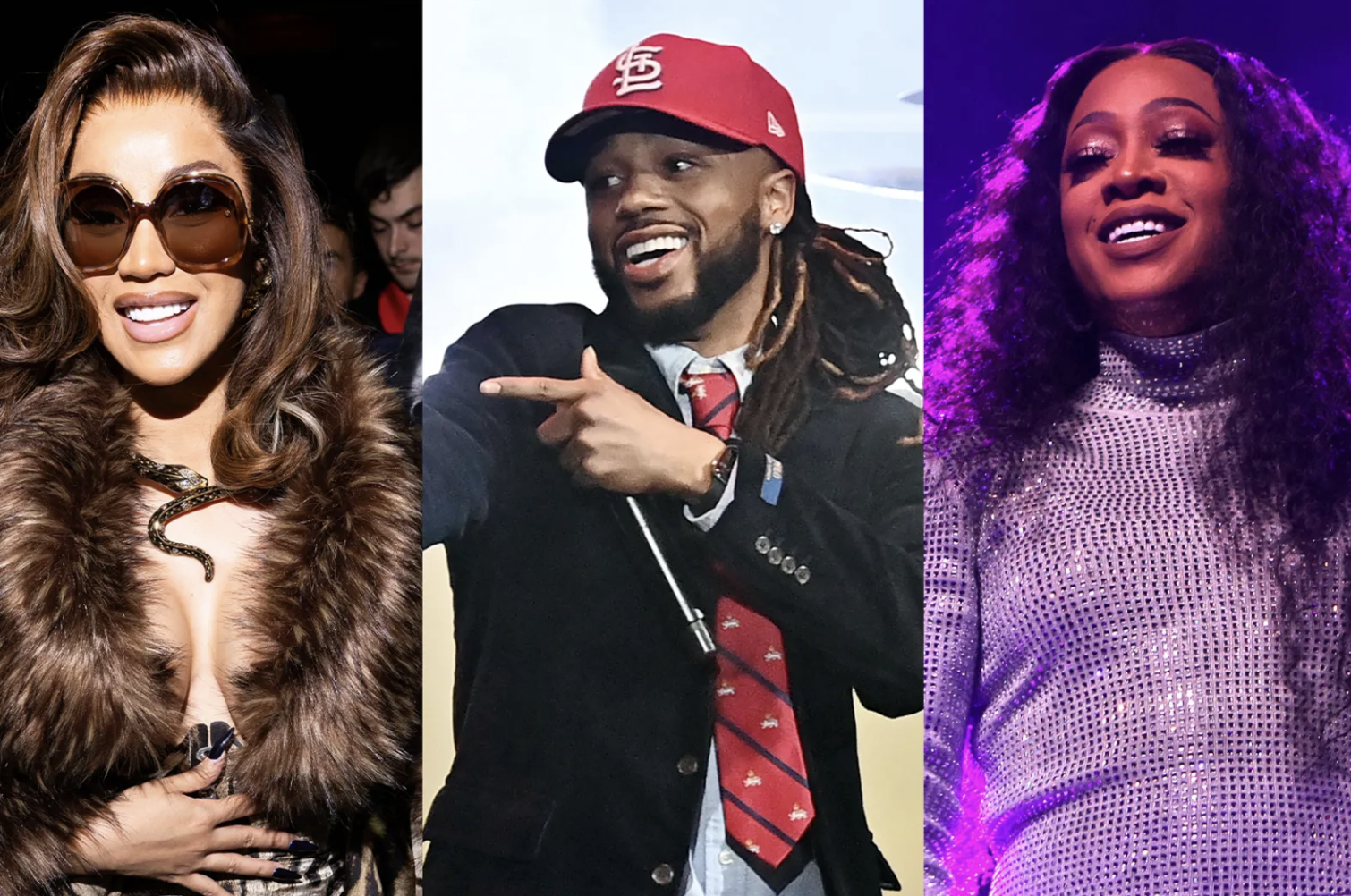
- The station is the Miami sound. Miami bass and Dirty South rap built the city’s musical identity long before Rockstar mapped it. Hiring the people who made it as hosts is the right move. It’s also an admission that the sound came from somewhere.
- The album is a release vehicle. GTA has become a platform for launching new music, the way Dr. Dre released six songs through GTA Online in 2021. The game now distributes hip-hop as much as it licenses it.
- The festival is the cultural layer, live. Vice City’s soundtrack goes back onto a real Miami stage, where the culture it borrowed from can be seen and heard.
GTA VI’s radio isn’t only hip-hop. Lana Del Rey and Morgan Wallen host a country station, Bad Bunny and RaiNao a Latin station, Robyn and Alex Consani a pop station, and Justice composed the score. This brief scores the hip-hop and Miami Black cultural layer specifically, and says so in the numbers.
A real rapper in the club. A rap label in the plot.
On November 5, Rockstar released 39 new screenshots to mark two weeks to launch. One showed Kodak Black as a non-player character, holding a cup with the logo of the Jack of Hearts, an in-game club that has run through the marketing and that Travis Scott name-checks on “RHYNO.” IGN reported that the reveal set off speculation about which other artists appear in the game. There’s precedent: Dr. Dre appeared as a character in GTA Online, and real DJs have played its nightclubs.
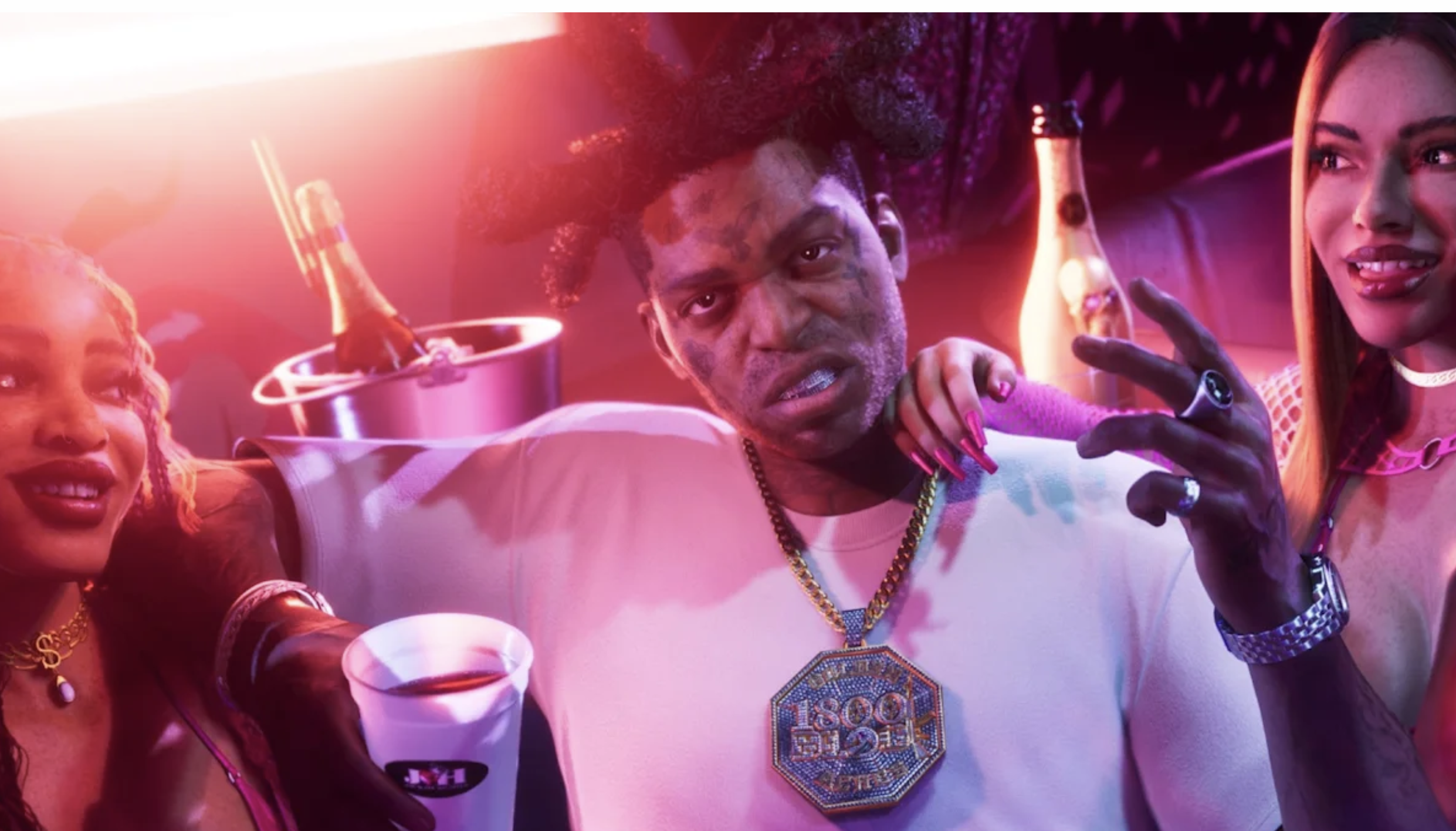
The story carries the culture too. Two of the game’s characters, Bae-Luxe and Roxy, rap as Real Dimez, played by real-life performers Hood Brat and Krissy Celess. They have signed to Only Raw Records, run by Dre’Quan Priest, who used to book acts at his partner Boobie Ike’s strip club. Rolling Stone notes that he scouts music through the club’s dancers. That is a recognizable portrait of how Southern rap hits have actually broken, written into a $1.84 billion product.
| Element | Cultural input | Dimension |
|---|---|---|
| Kodak BlackNPC · Jack of Hearts club | A real artist’s face and persona rendered as a game asset. Also on the launch-festival bill. | LIP · D3 |
| Trick Daddy & TrinaHosts · Dirty South Classics | Two of Miami’s best-known rap voices. Voice is likeness in audio. | LIP · HLM |
| Real DimezHood Brat · Krissy Celess | A rap duo storyline performed by real artists. | LIP · CIS |
| Only Raw RecordsDre’Quan Priest · Boobie Ike | The strip-club-to-radio pipeline of Southern hip-hop, portrayed as a plot. | CIS · HLM |
| Dirty South catalogSlip-N-Slide · Ted Lucas | Licensed recordings that define the Miami sound, 1999 onward. | CUV · HLM |
| Nine1NineE11even rebrand · Nov 6 | A real Miami club renamed for its in-game version, opened by Flo Rida. | CUV |
| Miami Heat × Vice CityNov 18 · Nike × Cactus Jack | Jerseys and merchandise designed with Travis Scott’s Cactus Jack Records. | CUV · CCI |
Rockstar built this with care. Its writers spent years in Miami from 2015, talking to club promoters, ex-criminals, police and locals, and cross-checking what they heard against books and journalism. Writer Michael Wiafe described the goal as replicating Miami’s culture with “an open mind, a genuine appreciation and a deep curiosity.” The studio said it avoided the crude jokes about marginalized groups that earlier games made, and it confirmed that no generative AI was used in the game. The research was real. The record of where it came from doesn’t exist. The people who sat for those interviews and the scenes they described aren’t credited as sources of the property.
Contracted talent, uncredited lineage
The artists named in this section were hired, licensed or cast, and this brief assumes they were paid on their contracts. The gap is elsewhere. Contracts price individual performances. Nothing records the culture those performances come from: the Miami sound, the club economy and the neighborhoods the composite characters were drawn from. In CPRS™ terms, that is uncredited aesthetic lineage, not copying. It is a missing field, not a dispute.
Twenty-five years of Black voices on GTA radio
GTA VI didn’t discover hip-hop. The franchise has drawn on Black artists, DJs and writers for a quarter century, and each game has leaned on them harder. Rolling Stone put it simply: recognizing a voice on the radio was part of getting comfortable in a city you were meant to tear apart.
Read as a rights timeline, the pattern is clear. With each game the culture moves from background to foreground: from DJs to writers, to voice actors, to artists releasing music through the game, to a real rapper’s likeness inside it. GTA V has sold nearly 235 million copies. The franchise is a 25-year distribution system for Black cultural property, and the lineage that feeds it has never been recorded as a contributor.
BCPV 88.10 — Tier 4 Landmark
This pass scores the cultural layer of GTA VI: the hip-hop sound, artist likeness, rap-business storyline and Miami Black cultural lineage built into the game and its launch. It doesn’t value the game, its code or Rockstar’s intellectual property. It is a soft pass built from public reporting, Sensor Tower estimates and CPRS™ modeling, not license fees or settlement data. It carries a confidence factor of 0.64, at the low end of the soft-pass range, because the game is one day old and the attributable share is modeled.
| Dimension | Weight | Score | Weighted |
|---|---|---|---|
| CISCultural Influence | ×0.30 | 96 | 28.80 |
| CCIConsumer Conversion | ×0.25 | 86 | 21.50 |
| LIPLikeness & Identity — D3 flagged (real-artist likeness and voice) | ×0.20 | 84 | 16.80 |
| CUVCommercial Usage | ×0.15 | 88 | 13.20 |
| HLMHeritage & Lineage (0–100 raw) | ×0.10 | 78 | 7.80 |
| BCPV | Tier 4 · Landmark | 88.10 | |
CIS 96. No cultural product in the series has circulated this widely this fast: 475 million trailer views in a day, 31.1 million Netflix views for a gameplay preview, a 99 on Metacritic, eight Game Awards nominations before release and a launch day treated as a holiday. The Dirty South sound and the artists around it reach that audience at full scale. It’s held below the ceiling because the influence belongs to the whole game, and the cultural layer is one of several inputs, alongside Latin, country, pop and electronic music.
CCI 86. Conversion is enormous: 19.05 million digital pre-orders, a reported 22% lift in PlayStation 5 console sales and a Miami-Dade advertising package worth $3.9 million. It’s held down for two reasons. Sensor Tower figures are third-party estimates, not company-reported settlement. And no data isolates how much of that conversion the cultural layer drove, so the brief models it (below).
LIP 84, the flagged dimension. Real identity is co-located in the product: Kodak Black’s likeness as an NPC, Trick Daddy and Trina’s voices on the radio, and Hood Brat and Krissy Celess performing Real Dimez. Voice is likeness in audio. It’s held below the 90s because the protagonists, Jason Duval and Lucia Caminos, aren’t drawn from this layer, and much of the cultural identity is carried by composite characters rather than named people.
CUV 88. Commercial use is extensive and unusually well papered at the talent level: licensed hosts, an Atlantic Records album, a live festival, a real club rebrand and Miami Heat jerseys and merchandise built with Nike and Cactus Jack. Rockstar refused every product-placement deal, so the culture is the only “real” brand inside Vice City. CUV is held below 90 because the layer underneath the contracts, the sound, the club economy and the city’s identity, is used without any recorded title.
HLM 78. The lineage is deep: Miami bass and Dirty South rap from the 1990s, Slip-N-Slide’s catalog, and 25 years of Black artists on GTA radio. It scores below the heritage range because custody is broken. The lineage is held inside a corporate publisher’s product, and none of its community custodians appears on any record.
Corporate-held velocity: CIS 96 over HLM 78
This is the inverse of the heritage-heavy shape. $HALIM carries HLM 80–92 inside composites below 63. $DIFFERENTWORLD (84.40) carries HLM 90 with a hollow commercial title. $GTAVI has the highest influence score in the series and its weakest custody. The culture is moving at maximum speed through a vehicle its originators don’t hold. The nearest comparables are $GRANDNATIONAL (92.60), which converted influence into settled box office, and $REESE (90.30), which is velocity-heavy. HLM is carried here as a 0–100 raw score at 10% weight, so the composites compare point for point.
From score to dollars
The Cultural Demand Coefficient for Music + Entertainment is 0.75 × 0.40 × 3.0 = 0.90, so the valuation index is 79.29 (88.10 × 0.90). For the dollar figure, the brief follows the Culture Market Data convention: each line of commerce is multiplied by its sector multiplier and the lines are summed. The base is deliberately narrow. It counts only the share of commerce attributable to the cultural layer, and every line carries a 30% realization discount.
| Line | Basis | Base | Multiplier | TCPMV |
|---|---|---|---|---|
| GAMEAttributable share · modeled | $1.84B Sensor Tower pre-launch estimate × 10% attributed to the cultural layer, less 30%. Physical and launch-day sales excluded. | $128.8M | 3.0× | $386.4M |
| MUSIC & LIVEAlbum · radio · festival · modeled | The hip-hop share of The Album, Dirty South Classics and the Mana Wynwood festival. Modeled at $15M, less 30%. No figures published. | $10.5M | 3.0× | $31.5M |
| APPARELHeat × Cactus Jack · modeled | Attributable share of Vice City jerseys and merchandise built with Nike and Cactus Jack. Modeled at $10M, less 30%. | $7.0M | 3.5× | $24.5M |
| LIKENESS FEESKodak Black · cast · hosts | Talent and appearance terms are private. Not modeled. | — | — | — |
| HOST CITYMiami-Dade · $3.9M package | Reported, but it buys the whole Vice City campaign, not the cultural layer. Held outside the base. | — | — | — |
| LONG TAILYears 2–10 | GTA V has averaged about $400M a year in its ninth to thirteenth years. Not counted. | — | — | — |
| TOTAL | Launch window · blended 3.02× | $146.3M | 3.02× | $442.4M |
The 10% share is the assumption that matters most, so it’s set low on purpose. The game draws on many cultures, and its protagonists don’t come from this layer. At 5% the TCPMV would be about $249 million. At 20% it would be about $829 million. All three cases place the property in Tier 4. The tier doesn’t depend on the assumption. Only the size of the band does.
Who captures the value, and who’s missing
Every cultural product this size has an economic stack underneath it. GTA VI’s top layers are some of the best-capitalized companies in entertainment. The bottom layer is the community the sound came from.
Rockstar Games & Take-Two
Owns the game, the characters and the engine. Take-Two forecasts record sales of more than $8 billion for its financial year. Rockstar turned down every brand deal, which leaves culture as the only real-world brand equity inside Vice City.
Sony, Microsoft, Netflix, Twitch
About 75% of pre-orders ran through PlayStation, which reported a 22% console lift. Netflix premiered the gameplay preview and topped its film chart in 87 of 93 countries. Twitch carried 1.9 million concurrent viewers on launch morning.
Hosts, artists & cast
Trick Daddy, Trina, Kodak Black, Hood Brat, Krissy Celess and the album artists. They’re paid on their contracts for performances and likeness. None holds a recorded interest in the cultural layer their work makes up, or in its decade-long tail.
Miami-Dade, the Heat & Miami venues
The county sold a $3.9 million advertising package. The Kaseya Center roof sign alone cost $975,000. E11even became Nine1Nine for a night. The mayor called it revenue for the community. Commissioner René García objected to depicting Miami as a crime haven.
The Miami culture the sound came from
The Dirty South scene, the independent labels, the clubs, DJs and dancers who broke the records, and the neighborhoods Rockstar’s researchers interviewed. This is the cultural input in the stack, and nothing routes back to it.
Likeness, Voice & AI
A real artist’s face built as a 3D asset, two of Miami’s best-known rap voices, and hundreds of hours of footage streamed worldwide. AI and synthetic exposure is modeled at 2–5× TCPMV, or $885M–$2.21B.
Rockstar used no generative AI. Everyone else will.
Rockstar confirmed GTA VI contains no generative AI. That protects the game, not the people in it. The moment the game shipped, millions of players started capturing Kodak Black’s in-game likeness, Trick Daddy and Trina’s voices and the Real Dimez performances. That footage is ideal training data for synthetic clips, voice models and fake “new” content. Leaks before launch already included suspected AI-generated GTA footage.
An artist’s game contract covers the game. It doesn’t give them a title to enforce against a synthetic copy of their in-game self. Register the severable .AI records for each likeness and voice before the clip economy sets the price at zero. Registration doesn’t stop replication. It gives the originators something to enforce with.
What registering the culture actually changes
A figure like $442 million invites the wrong reading, so here’s the precise one. TCPMV isn’t lost revenue and it isn’t a claim against Rockstar, Take-Two or any artist. It measures unstructured value: economic activity generated by a cultural property that no instrument currently describes, attributes or routes. Registration doesn’t touch Rockstar’s ownership of the game. It records the culture that sits inside it.
The lineage becomes a field
A record names the Dirty South scene, Slip-N-Slide’s catalog and the Miami culture as the cultural source of the layer, alongside the hosts and artists. The question the game raises becomes a matter of record.
The next deal starts from a number
A BCPV of 88.10 and a TCPMV band give the next artist, estate or city negotiating with a game studio a cultural-property benchmark, instead of a one-time fee.
In-game likeness becomes enforceable
Severing a .AI record for each likeness and voice turns a diffuse replication problem into a specific claim with a rate attached.
Community Return becomes automatic
On a modeled $442M TCPMV, a 4% Community Return is about $17.7 million, allocated by the CX Foundation to Health & Wellness, Culture Alignment, Entrepreneurship and Sustainable Communities in the places the culture came from.
How $GTAVI would register
Following the series convention, the cultural layer registers as a parent with severable records. Rockstar remains the game’s rights holder and would sit at the table as custodian of the product. The artists hold their own likeness records. The AI entries are the priority.
The talent and licensing terms are private
This brief can’t see the hosts’, artists’ or cast’s agreements, the scope of the likeness grants, or the music licenses and album splits. Those documents decide how much of the likeness and voice surface is already contracted to Rockstar and how much the artists can still register. They are the first things to review before any figure here is acted on. Rockstar’s ownership of the game itself is not in question.
Rockstar wouldn’t sell a single billboard in Vice City. It didn’t need to. The most valuable real-world brand in the game was the culture, and it came free of a ledger.
Rockstar built a city that 19 million people paid to enter before the doors opened, and it did it with care: years of research, real hosts, real artists and no generative shortcuts. That is exactly why this case is useful. If the most carefully made cultural product of the decade can still ship with no record of the culture inside it, the gap isn’t one company’s failure. It’s a missing piece of market infrastructure.
Markets recognize asset classes once someone builds the registry, publishes the method and makes the first entries. MADE CX built the financial infrastructure for $CULTURE to function as property. Vice City is the proof: culture is the cheat code.
Soft pass. Modeled from public reporting, not license fees, talent agreements or settlement data. Pre-launch sales (about 19.05 million digital units, $1.84 billion; 75% PS5 / 25% Xbox; record pre-orders) are Sensor Tower estimates via The Hollywood Reporter, NBC News (Nov 19, 2026) and Wikipedia. They track digital pre-sales only and exclude physical copies and launch-day sales. GTA V lifetime figures are from The Wall Street Journal via The Hollywood Reporter. First-week range ($3.3–5.2B) is Newzoo and the Take-Two forecast is from Creative Boom (Katy Cowan, Nov 18, 2026). Trailer, Netflix and Twitch figures are from NBC News, Creative Boom and Wikipedia. Dirty South Classics, the hosts’ statements, The Album and GTA’s hip-hop history are from Rolling Stone / VIBE (Jeff Ihaza, Nov 19, 2026). Kodak Black’s NPC appearance is from IGN via Yahoo (Cade Onder, Nov 5, 2026). Miami activations are from Adweek (Brittaney Kiefer, Nov 18, 2026), NBC News and Wikipedia. Cast, research, writing and the no-generative-AI confirmation are from the Wikipedia entry for Grand Theft Auto VI. Confidence factor 0.64. TCPMV is presented as a band ($310M–$619M), not a point.
Scope. The scored property is the hip-hop and Miami Black cultural layer of GTA VI: sound, artist likeness and voice, the rap-business storyline and the cultural lineage. It is not the game, its code, its characters or Rockstar’s intellectual property. The sources document sound, likeness and story. They don’t document in-game dialect or slang, and Rockstar has said it kept slang deliberately timeless, so this pass doesn’t score language.
Scoring and routing. BCPV = CIS×0.30 + CCI×0.25 + LIP×0.20 + CUV×0.15 + HLM×0.10, with HLM carried as a 0–100 raw score: 28.80 + 21.50 + 16.80 + 13.20 + 7.80 = 88.10. CDC = 0.75 × 0.40 × 3.0 (Music + Entertainment) = 0.90; index 79.29. Per series convention, sector multipliers are applied directly to each line: game and music at 3.0×, apparel at Fashion 3.5×; blended 3.02×. Tier is placed from the modeled TCPMV band (Tier 4 · Landmark). HLM 78 sits below the heritage range typical of Tier 4, so this is a band placement, not a heritage placement.
Attribution and discounts. The 10% attributable share of game commerce is a MADE CX modeling assumption, shown with a 5%–20% sensitivity ($249M–$829M TCPMV, Tier 4 throughout). Music, live and apparel lines are MADE CX estimates; no figures are published. Every line carries an explicit 30% realization discount. Likeness fees, the Miami-Dade package and the long tail are held outside the base.
Property valuation, not company value. TCPMV values the cultural layer and the commerce it moved in the launch window. It isn’t an estimate of any artist’s earnings, of Rockstar’s or Take-Two’s value, or of the game’s revenue, and it isn’t a price, appraisal or investment advice.
Unattributed ≠ unpaid. Figures describe cultural-property value flowing without CPRS™ attribution or community reinvestment. They don’t assert that any artist, host or performer was underpaid, that any agreement was breached, or that Rockstar Games, Take-Two, Atlantic Records, Sony, Microsoft, Miami-Dade County, the Miami Heat or any venue acted improperly. References to lineage describe uncredited aesthetic lineage, not copying. This is an independent analysis, not affiliated with or endorsed by Rockstar Games, Take-Two Interactive or any artist named. Grand Theft Auto, Vice City and related marks are © Rockstar Games / Take-Two Interactive; game footage and imagery are used for editorial identification.
Report GTA-CX-2611-037. Culture Market Data · MADE CX · November 19, 2026. Soft valuation, not an appraisal, not a registered record, not investment advice.