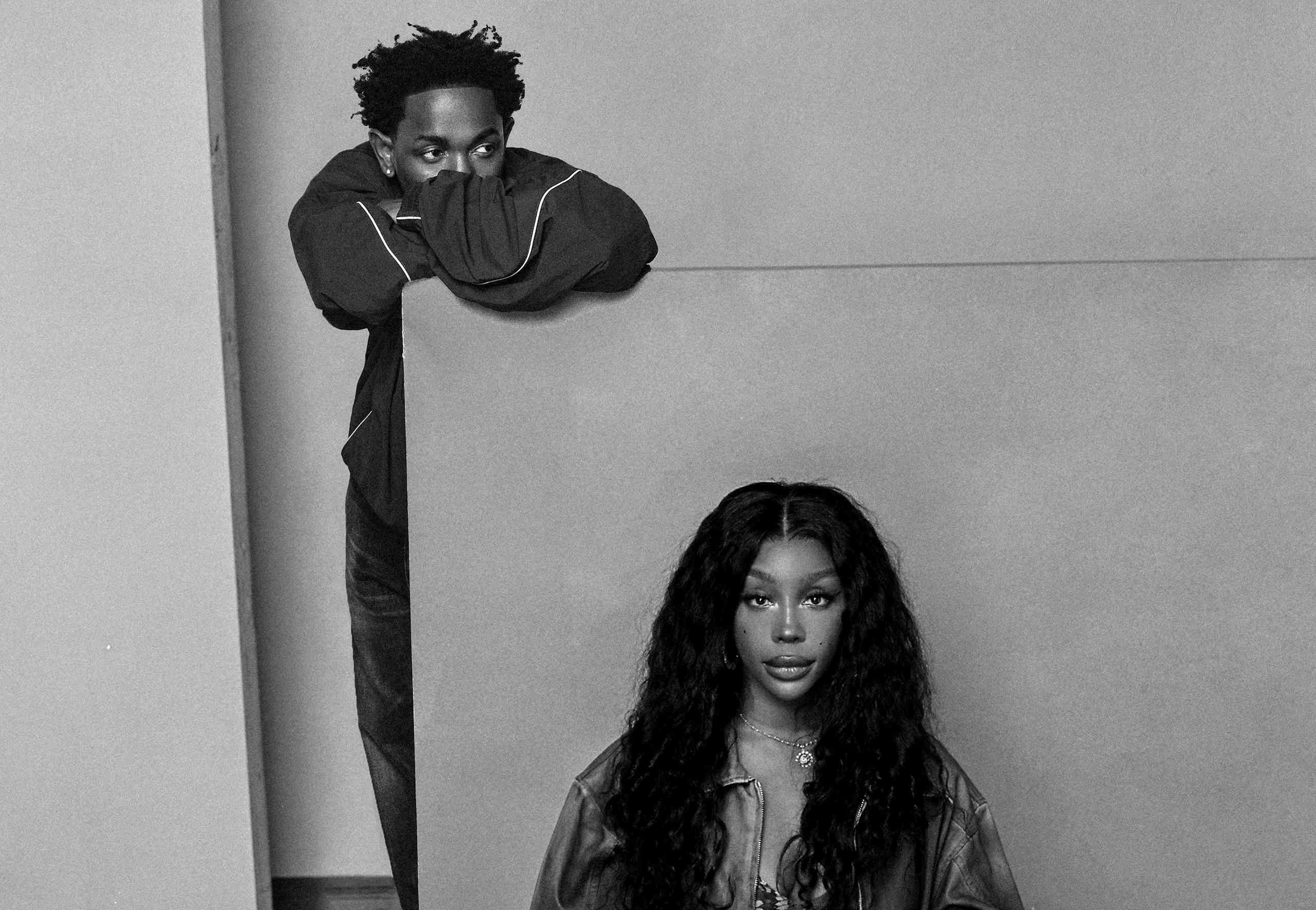
At the Super Bowl in February 2025, between songs, Kendrick Lamar told 133.5 million viewers that
"they tried to rig the game, but you can't fake influence." Ten weeks later he went out to prove it at the box office.
The receipts came back at $390.7 million. The argument that followed was about whose name the receipts belong under.
This report does four things. It puts a number on the cultural property underneath the Grand National Tour. It
answers the attribution fight that broke out when the record was announced. It measures what the tour put into the
cities that hosted it, using Deep Venue's city-by-city model. And it makes the case that none of this is
a matter of opinion or fandom. It is a missing layer of market infrastructure: a public ledger where cultural value is
registered, attributed and settled like any other asset class.
01 — The Run-Up
A diss track became a political anthem, then a halftime show, then a stadium tour
The Grand National Tour wasn't built on an album cycle alone. It was built on a single song that left the rap
feud it came from and entered the wider culture. "Not Like Us" was released on May 4, 2024, during Lamar's feud with
Drake. Within a year it had been played at a presidential campaign, a party convention, the Olympics, a Juneteenth
concert and the most-watched halftime show in history. The tour is where that influence was converted into
settled transactions.
May 4, 2024
"Not Like Us" released. Debuts at No. 1 on the Billboard Hot 100. Lamar reportedly lifted copyright claims for a limited time, which let the public use the song freely, including commercially.
Jun 19, 2024
The Pop Out: Ken & Friends. First live performance, on Juneteenth at the Kia Forum in Inglewood. He plays it five times in a row.
Summer 2024
It becomes a political and sports anthem. Used by Vice President Harris's campaign, as a California walk-on at the DNC roll call, by Baltimore Mayor Brandon Scott and by USA Basketball at the Paris Olympics. HBCU marching bands, including Southern's Human Jukebox and FAMU's Marching 100, add it to their shows. In Kenya it is sampled for a protest song against the Finance Bill.
Nov 22, 2024
GNX released. Lamar's sixth album includes two SZA collaborations, among them "Luther," which later spends 13 weeks at No. 1.
Dec 3, 2024
The tour is announced. Named, like the album, after the 1987 Buick Grand National Experimental. Presales run through tour sponsor Cash App and Ticketmaster.
Feb 2, 2025
Five Grammys, five nominations. Record and Song of the Year among them. "Not Like Us" ties "Up, Up and Away" as the most-awarded song in Grammy history.
Feb 9, 2025
Super Bowl LIX halftime. 133.5 million viewers, the most-watched halftime show on record. SZA appears as a guest. The staging and choreography become the tour's preview.
Apr 19 – Dec 11, 2025
Grand National Tour. Minneapolis to Sydney. 47 shows, 2.037 million tickets, $390.7 million. The first all-stadium tour for either artist.
Shows
47
4 continents · 1 cancelled (Bogotá)
Tickets sold
2.037M
~43,300 per show
Gross per show
$8.3M
Average across the run
Average ticket
$191.80
$390.7M ÷ 2.037M
Read the sequence the way a rights analyst would. The song generated its demand in public, much of it through
uses nobody paid for: campaign rallies, league broadcasts, marching bands, memes, a free-to-play video game that
drew 1.2 million players in 36 hours. Under the Cultural Property Rights Standard™, that uncompensated use is
evidence, not leakage. It is the demand signal that the tour then converted at stadium scale. Seattle's
Lumen Field show alone grossed $14.8 million from 60,941 tickets, setting the record for the
highest-grossing hip-hop concert at the time.
02 — The Attribution Question
The record belongs to a rapper. 92% of it was earned as a duet.
When the final numbers landed, the headline wrote itself: Kendrick Lamar now holds the highest-grossing tour by
a rapper in history. Fans immediately asked where SZA was in that sentence. TDE president Terrence "Punch"
Henderson, who signed both artists, weighed in publicly, per Complex. The commenters split along familiar lines. One
side said the stat was just "stating the facts." The other said two fanbases filled those stadiums.
Both sides are right, and the leg-by-leg data shows exactly how. SZA co-headlined the North American and European
legs. Lamar played Latin America and Australia alone. Split the gross along that line and the attribution
question gets a precise answer.
Share of $390.7M gross by billing
$358.7M91.8% · co-headlined · 39 shows · 1.76M tickets
$32.0M8.2% · Lamar solo · 8 shows · 275K tickets
| Leg | Billing | Shows | Tickets | Gross | Avg ticket |
|---|
| North AmericaApr 19 – Jun 18 · Billboard | Lamar × SZA | 23 | 1,100,000 | $256.4M | $233 |
| EuropeJul 2 – Aug 9 · derived from $358.71M co-headline total | Lamar × SZA | 16 | ~662,000 | $102.3M | ~$155 |
| Latin AmericaSep 23 – Oct 7 · Touring Data | Lamar solo | 4 | 149,428 | $14.1M | $95 |
| OceaniaDec 3 – 11 · Touring Data | Lamar solo | 4 | 125,610 | $17.8M | $142 |
| TOTAL | 47 shows | 47 | 2,037,000 | $390.7M | $192 |
Two more data points sharpen it. Lamar's previous tour, The Big Steppers, grossed $110.89 million.
SZA's SOS Tour grossed $113.12 million. Together that is $224.0 million. The co-headlined legs of the
Grand National Tour alone grossed $358.7 million, 1.6 times the sum of the two artists' previous solo
tours. The pairing produced value that neither artist's prior solo tour had shown. And the solo legs sold
at noticeably lower fill: 71% of capacity in São Paulo and 70% in Santiago, against 93% in Mexico City.
The stat is correct: it measures rappers. The asset it describes is jointly authored. A record book and a ledger
are different instruments, and only one of them has a column for co-authorship.
This is the attribution problem the Cultural Property Rights Standard™ was built to solve, playing out in public.
Record books and chart categories attribute by genre and by lead billing. They were never designed to say who authored
the demand. The joint works at the center of the show ("Luther," "All the Stars," "30 for 30," "Doves in the Wind")
carry both identities at once. SZA's catalog carried its own half of the night: after the tour opened,
SOS and GNX sat at No. 1 and No. 2 on the Billboard 200. A CPRS™ record would carry two originator seats on
this property. It would record each one's contribution by dimension rather than by headline.
03 — The Economic Impact
Every North American ticket put about $315 into its host city
Box office measures what happens inside the stadium. It doesn't capture what the crowd spends outside: hotels,
restaurants, rideshares, parking, retail. Deep Venue modeled that second flow for the North American leg, using
Billboard's reported attendance and a standard method: attendance × $185 local spend × 1.7 regional
multiplier. Box office and local impact are separate flows, so they add.
N. America box office
$256.4M
1.1M tickets · 23 shows
Local economic impact
$346M
1.1M × $185 × 1.7
City tax generated
$18.3M
~9% of visitor spend
N. America footprint
$602M
Box office + local impact
Footprint by city · 9 individually reported shows · $M
Box office (reported)Local impact (modeled)
Box office and attendance: Billboard Boxscore via Deep Venue. Local impact: attendance × $185 × 1.7. Bars share one scale; the longest is Inglewood's $86.7M.
The pattern in the chart matters for cities. In every market, the money the crowd spent outside the
stadium was larger than the money it spent on tickets. In St. Louis, where SZA was born, the Dome grossed
$8.8 million while the modeled local impact reached $15.3 million, 1.7 times the gate. Inglewood hosted three nights at
SoFi Stadium and absorbed an estimated $46.3 million in visitor spending, on top of $40.4 million at the box office.
| City | Venue · dates | Fans | Box office | Local impact | Footprint |
|---|
Extending the model worldwide
Deep Venue's model covers North America only. Applying the same method to the 937,000 international tickets
gives $294.7 million in local impact. The $185 spend figure is a U.S. benchmark, though, and spending norms differ in
São Paulo, Santiago and Melbourne. So this brief discounts the international extension by 30%, to
$206.3 million. Worldwide, the tour's modeled local impact comes to about $552
million, and its total economic footprint, box office plus local impact, to about $943 million.
Why the impact number matters for cultural property
Cities are downstream beneficiaries of an asset they don't hold
Host cities bid for stadium tours because the visitor economy is real and taxable: about $18.3 million in city tax
on the North American leg alone. That revenue is generated by a cultural property that no city, and no
originator, has registered. The same is true in smaller ways closer to home. After the "Not Like Us" video, Tam's
Burgers in Compton reported a 30–40% rise in sales and a surge of visitors, while other Compton businesses said they
lost thousands of dollars during the shoot and asked for compensation. Cultural property moves local money in both
directions. Right now there is no instrument that meters either one.
04 — The Valuation
BCPV 92.60 — Tier 4 Landmark
Scored across the five CPRS™ dimensions, $GRANDNATIONAL returns the highest reproducible composite in the Culture
Market Data series, above $REESE (90.30) and $DILLAGENCE2 (79.18). This is a soft pass. It uses public
reporting, Billboard and Touring Data box office, Deep Venue's impact model and CPRS™ structural coefficients, not
first-party settlement data. It carries a confidence factor of 0.72, higher than most soft passes
because 94% of the commerce base is settled box office rather than modeled estimates.
| Dimension | Weight | Score | Weighted |
|---|
| CISCultural Influence | ×0.30 | 97 | 29.10 |
| CCIConsumer Conversion | ×0.25 | 92 | 23.00 |
| LIPLikeness & Identity — D3 flagged | ×0.20 | 94 | 18.80 |
| CUVCommercial Usage | ×0.15 | 90 | 13.50 |
| HLMHeritage & Lineage (0–100 raw) | ×0.10 | 82 | 8.20 |
| BCPV | Tier 4 · Landmark | 92.60 |
CIS 97. Influence is documented across institutions, not just platforms. Five Grammys from five
nominations, tying the most-awarded song in the award's history. The most-watched halftime show ever, and an Emmy for
its music direction. The first rapper to pass 100 million monthly listeners on Spotify. Adoption by a presidential
campaign, a party convention, six major sports leagues and associations, USA Basketball and HBCU marching bands, plus a protest song in
Nairobi. Held below the ceiling because a share of the circulation was adversarial, driven by a feud rather than by
adoption.
CCI 92. This is the first record in the series where conversion rests on settled transactions
instead of sell-out claims: 2,037,000 tickets and $390.7 million in reported gross. After the tour opened, SOS
and GNX held the top two spots on the Billboard 200. The score is held down by the solo legs: São Paulo, Buenos
Aires and Santiago sold between 70% and 75% of capacity, and the Bogotá date was cancelled for logistical
reasons. Merchandise and per-head spend are not published.
LIP 94, the flagged dimension. Two fully formed identities are co-located in one product. Lamar's
sets run on camouflage, lockstep marching and the tinted GNX rising from under the stage. SZA's run on a garden world
of vines, praying-mantis dancers and a giant ant named Anthony. The show was designed to sell the contrast, and the
joint acts were built to sell the pairing. The attribution fight in Section 02 is, in CPRS™ terms, a dispute about
D3. This is the dimension where the property is widest and where the public record of who owns what is thinnest.
CUV 90. Commercial usage is extensive and mostly unpapered. There is a tour sponsor (Cash App), a
Ticketmaster Platinum presale and an HSBC presale in Mexico. "Not Like Us" has been used by the NBA, NFL, MLB, NCAA, MLS
and WNBA in broadcasts and social campaigns, and by the Dodgers after the 2025 World Series. Under the Framework,
CUV rises with documented uncompensated use, because that use is a demand signal. It is held below 95
because the sponsor and presale terms are private and most of the league usage has no visible license.
HLM 82. The lineage is deep and still being written. Compton, whose landmarks, from the MLK Memorial to
Tam's Burgers, anchor the "Not Like Us" video. The first Pulitzer Prize for Music awarded outside classical and
jazz. A decade of collaboration going back to SZA's 2014 EP Z. Top Dawg Entertainment, which signed Lamar in
2005 and made SZA its first female artist in 2013. Anita Baker's "Sweet Love" woven into Lamar's set. It scores below
the heritage-heavy range because two living careers and one tour year haven't yet built generational custody.
Fingerprint note
Settlement-heavy: every dimension at 82 or above
$HALIM's shape is heritage-heavy: HLM between 80 and 92 inside composites below 63. $REESE is velocity-heavy: CIS and LIP
in the 90s over an HLM of 78. $GRANDNATIONAL has no weak dimension, and it is the first record in the series
where CCI is anchored to settled box office. Calibration references: $REESE 90.30 (94 / 90 / 93 / 88 / 78) and
$DILLAGENCE2 79.18 (multiplier-form HLM). HLM is carried here as a 0–100 raw score at 10% weight, the form preferred
for new work because it keeps composites comparable.
From score to dollars
The Framework's Cultural Demand Coefficient for Music + Entertainment is 0.75 × 0.40 × 3.0 = 0.90, which puts the
valuation index at 83.34 (92.60 × 0.90). For the dollar figure, this brief follows the Culture Market
Data series convention: each line of observable commerce is multiplied by its sector multiplier and the lines are
summed. The commerce base is deliberately narrow. Settled box office makes up 94% of it. Two small modeled lines,
each carrying a 30% realization discount, make up the rest.
| Line | Basis | Base | Multiplier | TCPMV |
|---|
| LIVEBox office · settled | $390.7M reported gross across 47 shows. No discount applied: these are completed transactions. | $390.7M | 3.0× | $1,172.1M |
| MERCHTour merchandise · modeled | MADE CX assumption of $15 net per attendee × 2.037M, less a 30% realization discount. Figures are not published. | $21.4M | 3.5× | $74.9M |
| SPONSORPresale & partner · modeled | Cash App tour sponsorship, Ticketmaster Platinum and HSBC presales. Modeled at $8M, less 30%. Terms are private. | $5.6M | 4.5× | $25.2M |
| TOTAL | Tour window, Apr 19 – Dec 11, 2025 | $417.7M | 3.05× | $1,272.2M |
What the base leaves out is as important as what it includes. It excludes the streaming lift on GNX and
SOS, the Super Bowl, every league and campaign use of "Not Like Us," and the host-city visitor economy
measured in Section 03. Those flows are real, but they aren't reported in a form this pass can settle. Including them
would make the number bigger and less defensible.
Tier band (Framework)
$2M–$10M+
Tier 4 placed by band, not heritage
AI licensing extension
2–5×
$2.54B – $6.36B exposure
Community return at 4%
$50.9M
If registered · 80/16/4
Community flow today
$0
No CPRS™ attribution
05 — The Stack
Who captured the value, and in what order
Every cultural event this size has an economic stack underneath it. On this tour the top of the stack is
unusually well documented, because box office is public. The bottom is where the documentation stops.
Layer 01 · Originators
Kendrick Lamar & SZA
Artist guarantees and the split between the two headliners are private. Lamar now works through pgLang and a
direct licensing agreement with Interscope, after leaving TDE and Aftermath. SZA remains on TDE with RCA. Two
originators, two corporate structures, one jointly authored product, and no public instrument that records how the
property is shared.
Captured value: guarantees + splits · private
Layer 02 · Promoter & Ticketing
Live Nation & Ticketmaster
Live Nation is listed as promoter on the international legs, and Ticketmaster ran the Platinum presale. This layer
sees every transaction in real time. It holds the only complete settlement data for the tour, and none of it is
attributed to the cultural property that produced the demand.
Captured value: promoter margin + ticket fees
Layer 03 · Sponsor
Cash App & presale partners
The tour sponsor bought access to a fanbase at its most engaged moment, through presales that put its app between
fans and tickets. HSBC did the same in Mexico. The sponsorship is a license to borrow the property's reach. Its
terms are not public.
Captured value: user acquisition + brand halo
Layer 04 · Venues & Host Cities
SoFi, MetLife, Soldier Field and 20+ more
Stadiums take rent, concessions and parking. Host cities take visitor spending and tax: about $346 million and $18.3
million respectively in North America. This is the largest flow in the footprint and the one furthest from the
originators.
Captured value: ~$346M local impact · ~$18M tax
Layer 05 · Ambient
Leagues, Campaigns & Feeds
The NBA, NFL, MLB, the Dodgers, the Harris campaign, the DNC, broadcasters and social platforms all used "Not Like
Us" to move their own audiences. It is the least capturable layer, and precisely the one a community reinvestment
mechanism exists to reach.
Captured value: ratings, engagement, turnout
Layer 06 · Derivative ▲
Voice, Persona & AI
Two of the most recognizable voices in music, 47 nights of high-fidelity stadium footage and a halftime show
watched by 133.5 million people. AI and synthetic exposure is modeled at 2–5× TCPMV, or $2.54B–$6.36B.
This is the most replication-exposed layer in the stack, and it has no registered owner.
Captured value: unstructured, unpriced
D3 ▲ Critical — AI & synthetic exposure
One of the headliners has already named the threat
SZA has spoken publicly against generative AI music tools, arguing that they are trained heavily on Black
songwriters and producers. In 2026 she wrote that Black Americans "make up 13% of the American population yet
influence the world" with their sound, and have "no protection in legislature." That is the D3 problem stated by
an originator. A synthetic Kendrick verse or a generated SZA hook doesn't copy a recording, so copyright rarely
reaches it. What it copies is the identity.
Without a registry entry that sets scope, title and permitted use for each voice and persona, enforcement runs case
by case against every new model and platform. Registration doesn't stop replication. It gives both
originators something to enforce with, and a rate to enforce at.
06 — The Ledger
What registering this property actually changes
It is worth being precise, because the temptation with a figure like $1.27 billion is to imply that registration
would have deposited it somewhere. It wouldn't. TCPMV isn't lost revenue and it isn't a claim against anyone. It
measures unstructured value: economic activity generated by a cultural property that no instrument
currently describes, attributes or routes. Registration changes four things.
01 · Attribution
Co-authorship becomes a field
The record carries two originator seats and states each one's contribution by dimension. The question fans
argued about in the comments becomes a matter of record, settled by data rather than by who writes the
headline.
Replaces: the chart category
02 · Benchmark
The next tour negotiates from a number
A BCPV of 92.60 and a TCPMV band give the next promoter, sponsor or host-city conversation a cultural-property
benchmark instead of last year's grosses. That is the difference between a guarantee and a license.
Replaces: the gross-per-show comp
03 · Enforcement
Voices become enforceable titles
Severing an AI sub-property for each identity turns a diffuse replication problem into a specific claim. For two
of the most imitated voices in music, that is the single most valuable entry on the sheet.
Replaces: case-by-case takedowns
04 · Return
Community return becomes automatic
The 80/16/4 split routes 4% of participation into community reinvestment as a matter of structure. On a modeled
TCPMV of $1.27 billion, that is about $50.9 million, flowing to Compton, to St. Louis and to the
communities the culture came from, by design rather than by donation.
Replaces: one-off philanthropy
How this one would register
$GRANDNATIONAL registers as a joint event record with two originator seats: co-headlined legs held jointly, solo legs
attributed to Lamar. It sits beneath two parent career properties and next to the catalytic work that created the
demand. The AI surface is severed as its own entry and registered first.
Proposed Registry StructureCPRS™ · Soft Pass · Conf. 0.72
$GRANDNATIONAL Joint event record — 47 shows, Apr 19 – Dec 11, 2025 · Lamar × SZA (39 shows), Lamar solo (8)
92.60 Tier 4 · TCPMV $1.27B
$NOTLIKEUS Catalytic work — the song, the Pop Out, the halftime set · open appeal noted below
On scoping Separate registration
$KENDRICK · $SZA Parent career properties — likeness, catalog & influence, one per originator
On scoping Separate registrations
$GRANDNATIONAL.AI Severable AI / synthetic surface — two voices, two personas, stadium footage. Register first.
2–5× $2.54B – $6.36B unrealized
Community flow Current state, unregistered
$0 CPRS™ attribution
Execution constraint — primary gate
The co-headline terms are private
This brief can't see how the two headliners split the co-headlined gross, the promoter and sponsor terms, or the
publishing splits on the joint works. Those documents decide how much of the D3 surface is already contracted and
how much remains registrable. They are the first things to review before any figure here is acted on.
One encumbrance sits on the catalytic work. Drake's defamation suit against Universal Music Group over "Not Like Us"
was dismissed on October 9, 2025, and he filed an appeal on October 29. The appeal's outcome is not in this brief's
sources. $NOTLIKEUS should be scoped with that status confirmed.
The record book wrote down one name and one genre. What it couldn't write down was a jointly authored property that
moved about $943 million through the economy in a single year.
Lamar and SZA are, by any measure, two of the best-positioned originators in music. Between them they hold a Pulitzer, an Emmy and
34 Grammys, their own companies and a decade of shared work. That is exactly why this case is the useful one.
If a property this visible can generate a billion-dollar footprint while the public argues over whose name goes on the
record, the gap isn't a failure of either artist. It's a missing piece of market infrastructure.
Markets don't recognize asset classes because the value is obvious. They recognize them once someone builds the
registry, publishes the method and makes the first entries. The influence was never fake. It just hasn't been written
down.
Methodology & disclosure
Soft pass. Modeled from public reporting, not first-party settlement data. Tour gross, attendance and
show count come from Wikipedia (citing Billboard), Kiss 95.1 (Sep 28, 2026, citing Chart Data and XXL) and the
Complex post of late September 2026. North American leg totals ($256.4M, 1.1M tickets, 23 shows) are Billboard figures. Latin
American and Oceanian show data are from Touring Data (Sep 24, 2026). Touring Data lists the co-headlined tour at
$358.71M; the European leg ($102.3M, about 662,000 tickets, 16 shows) is derived by subtracting the North American
leg from that figure and is labeled as derived. Earlier reports placed the total at $332.1M from about 1.5M tickets,
before the final international dates were added. City-level box office, attendance and local impact are from Deep
Venue's Grand National Tour page (v1.0, Sep 29, 2026). Background on "Not Like Us," the Super Bowl, the artists'
careers and SZA's statements on AI is from the Wikipedia articles for each subject. Confidence factor 0.72. TCPMV is
presented as a band ($890M–$1.78B), not a point.
Scoring and routing. BCPV = CIS×0.30 + CCI×0.25 + LIP×0.20 + CUV×0.15 + HLM×0.10, with HLM carried as a
0–100 raw score. CDC = 0.75 × 0.40 × 3.0 (Music + Entertainment) = 0.90; index 83.34. Per Culture Market Data
convention, sector multipliers are applied directly to each line of the commerce base: live at 3.0×, merchandise at
Fashion 3.5×, sponsorship at Tech / fintech 4.5×. Tier is placed from the modeled TCPMV band (Tier 4 · Landmark),
not from the composite. HLM 82 is below the heritage range typical of Tier 4, so this is a band placement, not a
heritage placement.
Discounts. Box office is settled and carries no discount. Merchandise and sponsorship are not
published; both are MADE CX modeling assumptions with an explicit 30% realization discount. The international
extension of Deep Venue's local-impact model is discounted 30% because the $185 spend figure is a U.S. benchmark. The
worldwide impact ($552M) and footprint ($943M) are MADE CX extensions, not Deep Venue figures.
Property valuation, not earnings. TCPMV values the $GRANDNATIONAL cultural property and the commerce
it moved during the tour window. It is not an estimate of either artist's earnings, net worth or share of the gross,
and it is not a price, appraisal or investment advice.
Unattributed ≠ unpaid. Figures describe cultural-property value flowing without CPRS™ attribution or
community reinvestment. They do not assert that any party was underpaid, that any agreement was breached, or that
Live Nation, Ticketmaster, Cash App, any venue, league, campaign or label acted improperly. The attribution analysis
in Section 02 describes billing, not the private terms between the artists. Tour name and dates are used
descriptively; this is an independent analysis, not affiliated with or endorsed by the artists, promoters or venues.
Report KLS-CX-2609-029. Culture Market Data · MADE CX · September 29, 2026. Soft valuation, not an
appraisal, not a registered record. Economic impact data visualization courtesy of Deep Venue.