A cultural property doesn't become an asset because it's valuable. It becomes an asset
because someone writes it down. In late July 2026, the world's biggest doll brand, a $5-billion sneaker
brand and the fastest-appreciating league in American sports each wrote down a piece of Angel Reese.
Nobody wrote down the whole thing.
This report does three things. It puts a number on the property underneath the deal. It maps the
economic stack that captured the value, layer by layer. And it makes the case that the fix isn't
sentiment or goodwill. It's infrastructure: a public ledger where cultural value is registered, priced
and settled like any other asset class.
01 — The Event
Ten days, three institutions, one likeness
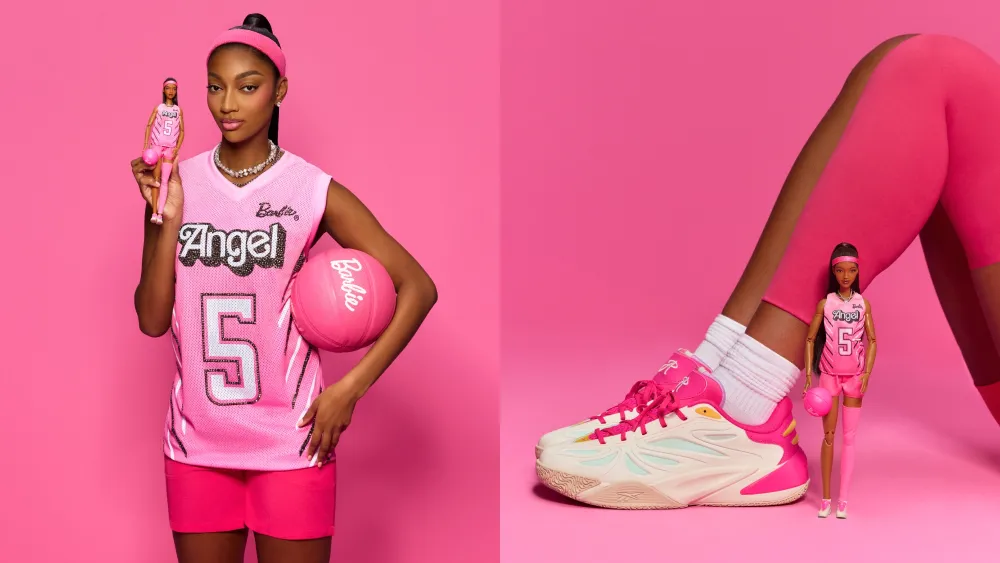
On July 24, 2026, Mattel unveiled a Barbie Signature doll of Angel Reese at the TOGETHXR House during
WNBA All-Star Weekend in Chicago. It's the brand's first Gen Z athlete doll, and Reese is
only the third WNBA player Barbie has ever made, after Hall of Famers Sue Bird and Rebecca Lobo. The doll
is "sculpted to her likeness," per Mattel's product listing. It wears a hot-pink jersey that carries both
her #5 and her #10, her single leg sleeve, her headband, layered necklaces, pink nails, and a miniature
of her own signature shoe. It ships with a Certificate of Authenticity and sells for just under $38.
It sold out at major retailers within days.
The next day she played in her third straight All-Star Game. On August 3, Reebok released a
Barbie-pink colorway of the Angel Reese 1 at $160: the same shoe the doll wears, at full scale. That
night, the Atlanta Dream hosted its first-ever Barbie Game Day at State Farm Arena
against the Las Vegas Aces, with ticket packages bundling a Barbie Dream headband, a crossbody bag and an
Angel Reese #5 Barbie Dream jersey. The doll sat beside her at media availability. Two days earlier, her
foundation's fourth annual Back to School Bash had put school supplies in the hands of 1,000 Atlanta-area
families.
Signature shoe
$160
Barbie AR1 · Aug 3
2026 salary
~$351K
Rookie scale · new CBA
Commerce moved
$496M
Modeled TCPMV
Read that sequence the way a rights analyst would. Three separate institutions, each with its own balance
sheet, its own trademarks and its own lawyers, coordinated a product calendar around one person's face,
body, jersey numbers, wardrobe and nickname. Mattel licensed the likeness into a collectible. Reebok
turned the collectible's shoe into a retail drop. The WNBA franchise turned both into a gate event. Each
step used the one before it as marketing. The only input all three shared was the one none of them owns.
"Angel Reese was the natural choice to be Barbie's first Gen Z athlete because she represents the next
generation of influence… reinforcing Barbie's place at the center of culture for a new generation."
Nathan Baynard — VP & Head of Barbie, Mattel, to Footwear News
That quote is worth reading twice. Mattel's head of Barbie is describing, in plain language, a
transaction in which Barbie is the buyer. The brand isn't lending Reese its cultural relevance. It's
borrowing hers. Mattel reported 2025 net sales of $5.35 billion, and worldwide gross billings for Dolls
of $2.06 billion, down 7%, "primarily due to declines in Barbie." A Ticketmaster figure
Mattel cited to FN says 71% of Gen Z female fans name women's basketball as their top sport. The
audience Barbie is trying to reach already has an address, and it runs through Reese.
The deal came three months after another market signal. In April 2026 the Chicago Sky traded Reese to
Atlanta for two first-round picks. Her jersey sold out in every size within 26 minutes of
the announcement. StubHub logged demand 15 times normal, the largest single-day spike in the Dream's
history. By August 3, just 15 home games in, the Dream had drawn 100,369 fans, which is more than the
98,560 it drew across all 20 home dates in 2025.
02 — The Lineage
Representation had a catalog. Ownership didn't.
The doll arrived with a public argument attached. Asked what dolls she played with growing up, Reese said
she "didn't have a lot of dolls" because she "didn't have dolls that really looked like" her. An OutKick
column answered with the record: Mattel introduced Christie in 1968 and the first doll named Black Barbie
in 1980; American Girl released Addy Walker in 1993; and in 1998 Mattel sold officially licensed
African-American NBA Barbie dolls in team uniforms. The column's conclusion was that the doll is "another
lucrative commercial opportunity," not a first.
Both readings get something right, and the record they share is the most useful evidence in this brief.
Read as a rights history, Barbie's Black lineage is a timeline of who got written down:
1968
Christie. Barbie's first Black friend character. A Mattel-owned character, not a person's likeness.
1980
Black Barbie. The first doll carrying the name, designed by Mattel's Kitty Black Perkins. The design authorship belongs to Mattel.
1993
Addy Walker. A fictional American Girl character (the brand joined Mattel in 1998).
1998
NBA Barbie. Licensed team uniforms. The league's marks were licensed and paid for. No player's likeness was in the product.
2026
Angel Reese. Sculpted to a living athlete's likeness, co-designed with her, wearing her own signature product. For the first time in this line, the person is the product.
That's the shift. For five decades the line licensed marks and owned characters. In 2026 it licenses a
human being's identity. The trademark changed hands in 1998 and got paid. The likeness in 2026 changed
hands under private terms, and there's no public instrument recording what it's worth. The persona also
came first. Reese called herself "Bayou Barbie" at LSU and rebranded as "ATL Barbie"
after the trade. The world's largest doll brand licensed a persona that an athlete built on her own,
which Footwear News called "a self-fulfilling prophecy." In CPRS™ terms, the cultural asset existed
before the contract did. The contract only recognized it.
The lineage runs through Baltimore, too. Reese played high school ball at St. Frances Academy and began
her college career at Maryland before winning a national title at LSU in 2023. A Baltimore-born
originator whose likeness now sits in the Barbie Signature catalog beside Marilyn Monroe and Venus
Williams is exactly the kind of property a place-based cultural registry exists to hold.
03 — The Market Failure
$CULTURE is not a recognized asset class
Every input in this deal has a market except one. The doll has a wholesale price and a retail margin. The
Barbie mark has a registration and a licensing department. The shoe has a cost of goods and a sell-through
report. The Dream has a Forbes valuation ($250 million, up 32% in a year) and a revenue multiple. The
league has an 11-year, $2.2-billion media-rights deal. Even Reese's salary sits on a cap sheet: roughly
$351,000 in 2026 under the new collective bargaining agreement, about 5% of a $7-million cap.
The cultural property itself is the compound of influence, likeness, lineage and commercial pull that
makes Mattel sculpt her face, Reebok time a drop and a franchise theme a night. It has none of that
infrastructure. No registry, no title, no comparable, no clearing house, no settlement layer. The value is
obvious enough that three public-facing institutions built a coordinated calendar around it, and it's
legible to no accounting system anywhere.
Economists would call this a straightforward market failure. A good is produced, consumed and monetized
at scale, but no property right attaches to it, so it can't be priced, traded or settled at its own layer.
The value doesn't disappear. It gets absorbed by whoever is standing next to it: the
licensor, the brand, the franchise, the platform selling ads against the highlight.
Why the structural data matters
Two of the three counterparties run on the culture they're buying
Per CPRS™ structural data, 88% of Reebok's company value derives from commercializing
Black culture, and 92% of the WNBA's value derives from leveraging it. Applied to the
public figures, that's roughly $4.4 billion of Reebok's reported $5 billion in annual retail sales, and
about $5.0 billion of the ~$5.4 billion combined value Forbes assigns to the league's 13 established
franchises. Reese isn't a guest in those numbers. Within the WNBA's current growth cycle she's one of its
two most-watched assets: an opening-week broadcast featuring her and Caitlin Clark drew 2.7 million
viewers, and the league's average franchise value rose 52% in a year.
Nobody in this story behaved badly. Mattel made a beautiful doll, co-designed with the athlete. Reebok
extended her deal and built her a signature line. The Dream traded for her and marketed her well. Reese
earned about $9 million off the court in 2025, per Forbes. There's no villain, and that's exactly why the
pattern survives. A failure with no perpetrator produces no correction. It just repeats, season after
season, moving value out of the communities that produce the culture and into the balance sheets of the
institutions positioned to capture it.
The OutKick column made the case that Reese is "incredibly privileged," and listed the evidence: the doll,
the shoe, the theme night, the trade, the Met Gala, the Victoria's Secret runway. Read through a
ledger, that list describes something else. Each item is another party's product built on her
property. The doll is Mattel's SKU. The shoe is Reebok's. The theme night is the Dream's gate. The
trade priced her at two first-round picks, and those picks went to Chicago. Being in demand isn't the
same as holding title.
Why CPRS™ matters here
The Cultural Property Rights Standard™ exists to close exactly this gap. It does one narrow, unglamorous
thing. It turns a cultural property into a formally described, scored, titled and auditable asset, so value
moving through it can be measured, attributed and reinvested instead of simply absorbed. Copyright
protects the photograph. Trademark protects Barbie's logo and Reebok's vector. Publicity law protects
against unauthorized use, case by case. None of them describe the property that
Mattel, Reebok and the WNBA are actually buying access to.
CPRS™ closes it with two mechanics. The first is a Base Cultural Property Value (BCPV):
a score across five weighted dimensions (Cultural Influence 0.30, Consumer Conversion 0.25, Likeness &
Identity 0.20, Commercial Usage 0.15, Heritage & Lineage 0.10) that produces a comparable number. The
second is a Total Cultural Property Market Value (TCPMV), derived by applying
sector-specific Cultural Demand Coefficients to the observable commerce the property generates. Together
they give a likeness deal something no endorsement rate card can: a benchmark.
04 — The Valuation
BCPV 90.30 — Tier 4 Landmark
Scored across the five CPRS™ dimensions, $REESE returns the second-highest composite in the Culture
Market Data series, behind only $LEBRON (96.35). This is a soft pass. It uses public reporting, industry
estimates and CPRS™ structural coefficients rather than first-party settlement data, and carries a
confidence factor of 0.68.
| Dimension | Weight | Score | Weighted |
|---|
| CISCultural Influence | ×0.30 | 94 | 28.20 |
| CCIConsumer Conversion | ×0.25 | 90 | 22.50 |
| LIPLikeness & Identity — D3 flagged | ×0.20 | 93 | 18.60 |
| CUVCommercial Usage | ×0.15 | 88 | 13.20 |
| HLMHeritage & Lineage (0–100 raw) | ×0.10 | 78 | 7.80 |
| BCPV | Tier 4 · Landmark | 90.30 |
CIS 94. Influence here is measurable in institutions, not just reach. The largest doll
brand in the world named her its first Gen Z athlete. She joins a WNBA doll lineage that had only two Hall
of Famers in it. She has three straight All-Star selections, three Met Galas and a Victoria's Secret
runway. Her nickname was adopted by the brand it borrowed from. Even hostile coverage counts: an OutKick
column is circulation. It's held below $LEBRON's 98 by career length. This is year three, and no league
has yet held its schedule for her.
CCI 90. Conversion is dense but mostly reported as sell-outs, not units. The doll sold out
within days at major retailers. The Angel Reese 1 sold out in minutes at its 2025 launch. Her Dream jersey
sold out in all sizes in 26 minutes. The Dream passed its full 2025 attendance in 15 home games. The score
is held down because none of this comes with published unit counts, so every retail line in the stack
below carries an explicit 30% realization discount.
LIP 93, the flagged dimension. This is the dimension the deal is literally made of.
Her likeness now exists as a manufactured, three-dimensional object sold to children ages 6 and up. It's
"sculpted to her likeness," carries her numbers, reproduces her single-leg-sleeve signature and wears her
shoe. Across Mattel, Reebok, the Dream, McDonald's, Victoria's Secret, Cash App, Good American and her own
podcast, the likeness runs on at least eight separate commercial surfaces. D3 is where the property is
widest and the paper is thinnest.
CUV 88. Commercial usage is elite for a third-year player. She has an extended Reebok
deal with a signature line, the Mattel license, a roster of national sponsors and about $9 million in 2025
off-court earnings per Forbes. The score is discounted for how much of the usage sits in partner-side
vehicles rather than the originator's own, and for a rookie-scale salary that is still her only
league-side instrument.
HLM 78. The lineage is real and still being written: Baltimore, St. Frances Academy,
Maryland, an LSU national title, "Bayou Barbie" to "ATL Barbie," and a foundation now in its fourth year of
community programming. It now also sits inside Barbie's own 58-year Black lineage. It scores below the
heritage-heavy range because a three-season career hasn't yet accrued generational custody. That's the
one dimension time raises on its own.
Fingerprint note
Velocity-heavy: CIS and LIP in the 90s over an HLM in the 70s
This is the inverse of the heritage-heavy $HALIM shape (HLM 80–92 inside sub-63 composites). $REESE is a
property whose recognition has outrun its tenure. Calibration references: $LEBRON 96.35 (Tier 4, 24-season
lineage) and $DILLAGENCE2 79.18 (Tier 4, heritage placement). On current trajectory, HLM is the dimension
with the most room to climb, and each season of documented custody moves the composite toward the
$LEBRON range.
Commerce base
$142M
Observable, modeled, net
Blended CDC
3.50×
Sports / fashion / ent.
Modeled TCPMV
$496M
$350M – $685M
Unaccounted
~$486M
No CPRS™ attribution
TCPMV applies a blended Cultural Demand Coefficient to an observable commerce base of about $142 million.
That base is the modeled, attributable slice of commerce the property sets in motion across seven sectors
between All-Star Weekend and the end of the 2026 season. The blend draws on the sectors the property
actually crosses: Sports at 3.8×, Fashion & Footwear at 3.5×, Music & Entertainment at 3.0× (where
toys and collectibles are routed, since the Framework lists no toy multiplier), a 3.4× blend for the
national sponsor roster, and Tech / AI-data at 4.5× for platform layers. Weighted, that's
3.50×, or $496 million.
05 — The Stack
Who captured the value, and in what order
Every cultural event this size has an economic stack underneath it. The order tells the story better than
the totals, because capture runs cleanly from the top of the stack down and stops one layer short of the
bottom. Each sector base below is a modeled estimate of deal-window commerce attributable to the property,
before the CDC is applied. Retail lines without published unit data are shown net of the 30% realization
discount.
| Sector | What the property moves | Base | CDC | TCPMV |
|---|
| WNBA · DreamGate, league & broadcast | Record attendance, ticket prices up from $38 to $68 at the opener, Barbie Game Day packages, All-Star, national windows. | $38M | 3.8× | $144M |
| ReebokSignature line | Angel Reese 1 line incl. the $160 Barbie colorway (Aug 3). Net of discount. | $28M | 3.5× | $98M |
| Mattel · BarbieDoll, capsule, Gen Z halo | The ~$38 Signature doll (sold out), the apparel capsule and brand reach into a Gen Z audience. Net of discount. | $22M | 3.0× | $66M |
| SponsorsMcDonald's · VS · Cash App · Good American | National campaigns running on the likeness during the window. | $20M | 3.4× | $68M |
| MediaBroadcast · TOGETHXR · podcast | Ratings, ad rates, the "Dream Closet" pop-up, and content volume across All-Star and the season. | $14M | 3.0× | $42M |
| MerchDream · Barbie Dream jersey | #5 jerseys (sold out in 26 minutes) and the co-branded Barbie Dream jersey. Net of discount. | $12M | 3.5× | $42M |
| SocialIG · TikTok · X · resale | Attention and ad value from the reveal, the drop and the secondary market (StubHub demand 15× normal). | $8M | 4.5× | $36M |
| TOTAL | Observable commerce · blended CDC 3.50× | $142M | 3.50× | $496M |
Layer 01 · Originator
Angel Reese
Captures a ~$351K rookie-scale salary, a 2027 team option at ~$396K, and endorsement income (about
$9M off the court in 2025, per Forbes). That's real and elite for her league. Against a ~$496M property
it's thin: the most marketed player in women's basketball personally settles about 2% of the value
her likeness moves.
Captured value: salary + endorsements (~$10M)
Layer 02 · Licensor
Mattel
Converts the likeness into a SKU and a Gen Z bridge for a brand whose Dolls billings fell 7% in 2025.
Mattel owns the doll, the mold, the packaging and the Barbie marks. The Signature doll's
Certificate of Authenticity certifies Mattel's product, not the property it reproduces.
Captured value: doll margin + brand reach
Layer 03 · Brand
Reebok
Turns the doll's shoe into a full-scale drop. Owned by Authentic Brands Group (acquired for at least
$2.5B in 2022) and now at about $5B in annual retail sales. Per CPRS™ structural data, 88% of Reebok's
value derives from commercializing Black culture. The signature line is the visible instrument. The
property underneath it is the unpriced one.
Captured value: signature margin + brand equity
Layer 04 · League & Franchise
WNBA & Atlanta Dream
The Dream paid two first-round picks for her, then themed a night on her. The league's average
franchise value rose 52% to $414M. Per CPRS™ structural data, 92% of WNBA value derives from leveraging
Black culture. No cultural-property license changed hands, and under current structures none has to. The
value captured is real, and it's unattributed.
Captured value: gate + franchise appreciation
Layer 05 · Ambient
Media, Merch & Feeds
Networks, resellers, sponsors and social platforms selling attention against the reveal and the drop.
This is where much of the headline number lives. It's the least capturable layer, and precisely the
layer a community reinvestment mechanism exists to reach.
Captured value: ad, resale + retail spend
Layer 06 · Derivative ▲
Likeness, Sculpt & AI
A production sculpt of her face and body now exists as a manufacturing asset, on top of three seasons
of high-fidelity broadcast, photography and campaign imagery. AI and synthetic exposure is modeled at
2–5× TCPMV, or $1.0B–$2.5B. The most-reproduced face in her league is the most
replication-exposed asset in the stack.
Captured value: unstructured, unpriced
D3 ▲ Critical — AI & synthetic exposure
The likeness is now a manufactured object
Most athletes' likeness risk lives in photographs. Reese's now also lives in a three-dimensional
production sculpt, sold into a child-facing market. AI and synthetic exposure scales with recognition and
fidelity, and this property now has both at their highest point: deepfake endorsements, synthetic voice
from podcast audio, unlicensed 3D likeness in games and generated product imagery. All of it attaches to
D3. Without a registry entry establishing scope, title and permitted use, enforcement runs case by case
against each new surface. Registration doesn't stop replication. It gives you something to enforce with.
06 — The Ledger
What registering on MADE CX actually changes
It's worth being precise, because the temptation with a number like ~$486 million is to imply registration
would have deposited it in someone's account. It wouldn't. The unaccounted figure isn't lost revenue. It's
unstructured value: economic activity generated by a cultural property that no instrument
currently describes, meters or routes. MADE CX is built to be that instrument, a public ledger for
cultural commerce. Four things change the moment a property has an entry.
01 · Scope
Scope becomes documented
The property gets described once, formally: the likeness, the numbers, the leg sleeve, the persona, the
lineage from "Bayou" to "ATL." Every later negotiation, whether a doll renewal, a new colorway or a
sponsor clause, starts from a document instead of from memory.
Replaces: institutional recollection
02 · Price
Value becomes comparable
A BCPV of 90.30 and a TCPMV band give the next Mattel, Reebok or franchise conversation a
cultural-property benchmark instead of an endorsement rate card. That's the difference between an
appearance fee and a license, and between a rookie-scale anchor and a market comp.
Replaces: the endorsement rate card
03 · Enforcement
AI exposure becomes enforceable
A registry entry establishing scope and permitted use turns a diffuse replication problem into a
specific claim. Right now that's the single most valuable thing a sculpted, child-facing likeness can
hold. You can't enforce a reputation. You can enforce a title.
Replaces: case-by-case takedowns
04 · Return
Community return becomes automatic
The 80/16/4 split routes 4% of participation into community reinvestment as a matter of structure, not
generosity. On a modeled TCPMV of ~$496M, that 4% is about $20M, flowing to the
communities the culture came from by design rather than by goodwill.
Replaces: goodwill and philanthropy
How this one would register
Following the series convention, $REESE registers as a parent property: the career likeness, persona and
influence asset. The July–August 2026 Barbie × Reebok × Dream window is split out as a discrete
sub-property, and the AI and synthetic surface is severed as its own entry before any further 3D or
likeness digitization. The three have different rights profiles and durations. The parent is a compounding
career asset. The sub-property is a bounded, high-intensity event with its own retail, gate and media
window. The AI entry is the priority.
Proposed Registry StructureCPRS™ · Soft Pass · Conf. 0.68
$REESE Parent — career likeness, persona & influence property
90.30 Tier 4 · TCPMV $496M
$REESE5 Sub-property — Barbie doll, AR1 Barbie colorway & Barbie Game Day, Jul 24–Aug 3, 2026
90.75 Tier 4 · TCPMV ~$173M
$REESE.AI Severable AI / synthetic surface — sculpt, voice, image. Register first.
2–5× $1.0B–$2.5B unrealized
Community flow Current state, unregistered
$0 CPRS™ attribution
Execution constraint — primary gate
The Mattel and Reebok terms are private
This brief can't see the scope, duration, territory or royalty structure of either license, or who owns
the production sculpt and its digital files. Those terms decide how much of D3 is already contracted away
and how much remains registrable. They're the first documents to review before any figure here is acted
on, and the first fields a Day-0 registration would capture.
The doll is the floor, not the ceiling. What got written down was a $38 SKU, a $160 shoe and a
rookie-scale contract. What's still unpriced is a Tier 4 likeness moving a nine-figure economy.
Reese is, by most measures, one of the best-structured originators her league has produced. She built her
own persona before any brand bought into it, she co-designed the doll, she ideates her own colorways, and
she runs a foundation. That's exactly why this case is the useful one. If a property this well managed
still has a nine-figure layer running through the public economy without a ledger entry, while the one
number her league writes down stays at rookie scale, the gap isn't a failure of any individual originator.
It's a missing piece of market infrastructure.
Markets don't recognize asset classes because the value is self-evident. They recognize them because
someone builds the registry, publishes the method and makes the first entries. That's the work.
Methodology & disclosure
Soft pass. Modeled from public reporting, industry estimates and CPRS™ structural
coefficients, not first-party settlement data. The doll launch, shoe release, Barbie Game Day, quotes and
prices come from Footwear News (Jul 24, 2026), Mattel's product listing, OutKick (Aug 4, 2026), CBS
Atlanta and The Black Wall Street Times. Salary figures are from Just Women's Sports (new CBA), earnings
from Forbes via Essence, franchise values from Forbes (May 2026), Mattel financials from its FY2025
results, Reebok figures from public reporting, and attendance and ticket data from EssentiallySports,
Front Office Sports and Essence. Sector commerce bases are MADE CX models attributable to the deal
window, presented as estimates. Confidence factor 0.68. TCPMV is presented as a band ($350M–$685M), not a point.
Discounts and routing. Retail lines without published unit data (Mattel, Reebok, merch)
carry an explicit 30% realization discount: sold-out is evidence of demand, not a sales figure. Toys and
collectibles have no Framework multiplier and are routed at Music & Entertainment (3.0×). The sponsor
line blends Food/Beverage (2.5×), Beauty (3.2×), Fashion (3.5×) and Tech (4.5×) equally, to 3.4×. Per
Culture Market Data series convention (see $LEBRON), sector multipliers are applied directly to the
commerce base. HLM is carried as a 0–100 raw score at 10% weight inside BCPV.
Tier placement. Tier is placed from the modeled TCPMV band (Tier 4 · Landmark, $2M+), not
the raw composite. HLM 78 sits below the heritage range typical of Tier 4 records, so this is a band
placement, not a heritage placement.
CPRS™ structural data. The coefficients cited (88% of Reebok's company value from
commercializing Black culture, 92% of WNBA value from leveraging Black culture) are proprietary CPRS™
figures used as modeling inputs. They aren't independently audited public statistics and are labeled as
CPRS™ structural data throughout.
Property valuation, not net worth. TCPMV values the $REESE cultural property and its
sub-property, meaning the commerce the likeness moves across the stack. It isn't a valuation of Angel
Reese's personal net worth, earnings or business holdings, and it isn't a price, appraisal or investment
advice.
Unaccounted ≠ unpaid. The ~$486M downstream figure describes cultural-property value
flowing without CPRS™ attribution or community reinvestment. It doesn't assert that any party was
underpaid, that any agreement was breached, or that Mattel, Reebok, the WNBA, the Atlanta Dream or any
other institution acted improperly. Barbie is a trademark of Mattel, Inc. Reebok is a trademark of
Authentic Brands Group. Their use here is descriptive.
Report ARE-CX-2609-028. Culture Market Data · MADE CX · September 2026. Soft valuation,
not an appraisal, not a registered record.