Founder's Note · No. 09
Founder's Note · No. 09 · September 2026
MADE CX · CPRS White Paper Series · In Response to Vogue

Fashion Week has a founder.

In 1969, Ophelia DeVore put a runway in Bryant Park — twenty-four years before the tents. Vogue found the record this week, in the middle of New York Fashion Week. The industry never issued the title.

Ophelia DeVore (1922–2014) · Photo: DeVore family

Fashion didn't forget the runway.
It forgot who demonstrated it first.

On Wednesday, while the shows were loading in, Vogue published a piece of reporting it will have to live with. Under Richard Morgan's byline, the magazine traced the runway model that New York Fashion Week commercialized back to a woman its own archive had mentioned once, in passing: Ophelia DeVore.1

The facts are not soft. As early as 1969 — twenty-four years before the industry's formal tents went up in the same park — DeVore's Grace Del Marco models were walking a runway in Bryant Park at lunchtime, in weeklong open-air shows the Amsterdam News called “fashion extravaganzas.” Sponsored days. City permits with rain dates. A five-hundred-person cap. A day set aside exclusively for Black designers.2 Everything that would later be sold to the world as Fashion Week, except the tents and the credit.

The Smithsonian says as much on a placard beneath one of her dresses: The Roots of New York Fashion Week. “The shows were so impressive that white marketers decided to appropriate the shows, adding tents and inviting top designers worldwide.”3 Then the placard goes vague — no years, no names — and the museum's press office declined to fill the gaps. That vagueness is the story. Not that the runway idea was lost. The idea was kept, scaled, exported to Paris, Milan and London.4 What was lost was the person, because nothing in the system ever attached her name to the asset.

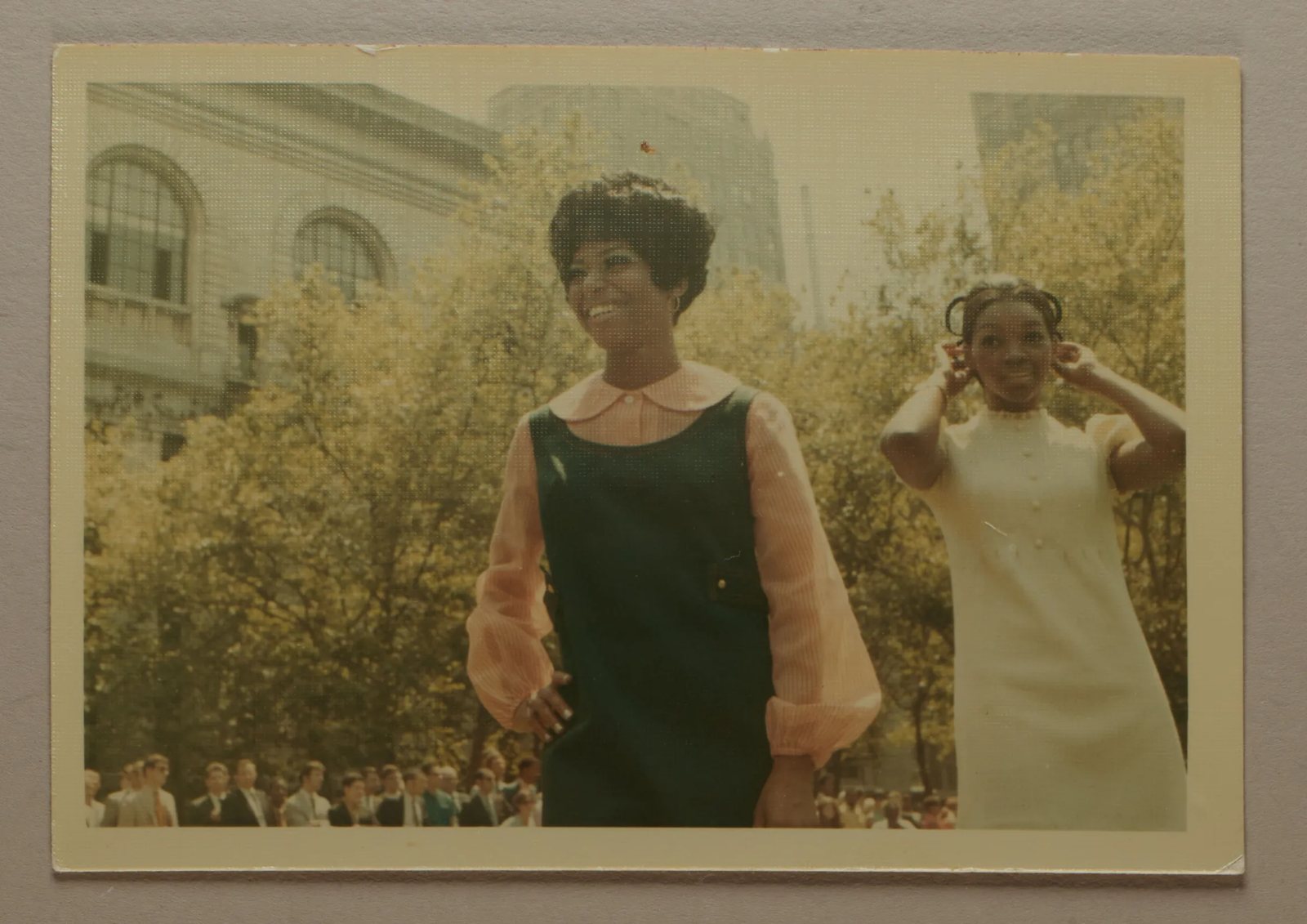
Faded color snapshot of two Black models on an outdoor runway in Bryant Park, one in a green jumper over a pink blouse smiling to the side, the New York Public Library and a crowd of onlookers behind them
“Fashions in the Park,” Bryant Park, c. 1969–70. Grace Del Marco models on DeVore's lunchtime runway; the New York Public Library behind them. Photo: courtesy of Emory University, via Vogue.

This is the cleanest example this series has had of the thesis it has argued for eight volumes. An industry event, created by a Black creator, is not treated as her property. It is treated as weather — something that happened in a park, that anyone could walk into and build on. And when the record is that thin, “forgetting” is not an accident of memory. It is the default output of a system that never recorded a title.

Weeklong. Permitted.
Sponsored. Commentated.

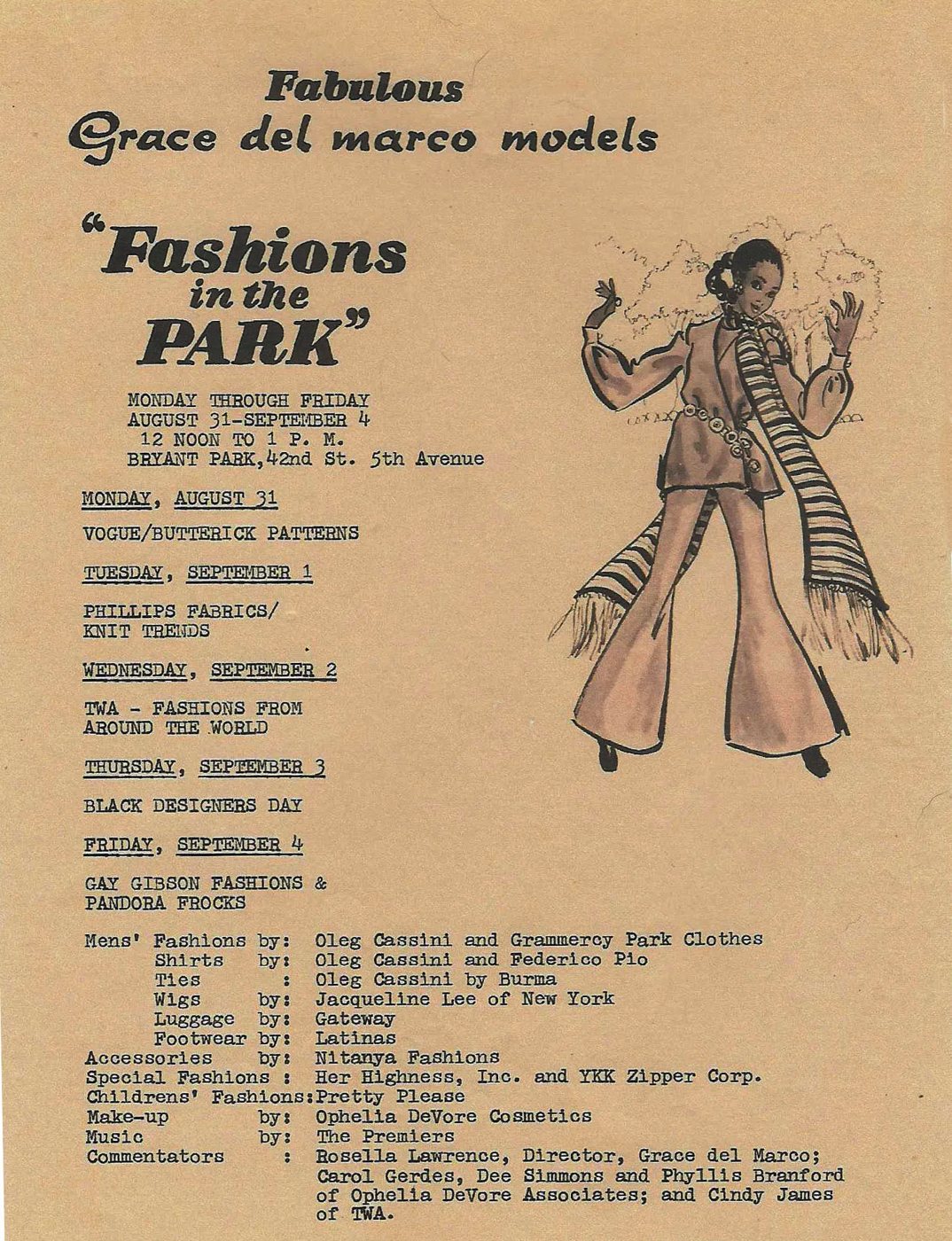
Read the flyer as a term sheet, not a keepsake. Every structural element of a modern fashion week is on one typed page from 1970 — and the maker's name is on it, twice.

1946
Grace Del Marco Agency founded
DeVore and four partners open one of the first modeling agencies in America and the first serious market for non-white models; sole owner by 1948.5
1955
Spotlight on Harlem, ABC
Co-hosts New York's first television program produced by and for Black Americans; models of color on air, weekly.5
1959
Cannes, then Dior
A Del Marco model, Cecelia Cooper, is the first American and first Black woman to win Miss Festival at Cannes; Dior then draws Helen Williams from the Del Marco roster.1
1969
First “Fashions in the Park,” Bryant Park
Weeklong lunchtime runway shows; Black, Asian and Spanish-speaking models, adults and children; garments contributed by major manufacturers and fashion houses. DeVore commentates.2The asset is demonstrated
Aug 31 –
Sep 4, 1970
The documented week
Vogue/Butterick Patterns · Phillips Fabrics · TWA “Fashions from Around the World” · Black Designers Day · Gay Gibson & Pandora Frocks. Menswear by Oleg Cassini. Music by The Premiers. Capped at 500 by City Hall permit.6
1973 · 75 · 84
Paris. Milan. London.
The fashion-week format is exported and formalized abroad on the heels of New York's “Black is beautiful” energy.4
1993
The tents go up in Bryant Park
The industry's formal Fashion Week arrives in the same park, twenty-four years later, and is remembered as the beginning.1The title is issued to someone else
2006 · 2010 · 2014
Agency closes. Tents leave. DeVore dies at 92.
Neither of her two New York Times obituaries mentions Bryant Park. Nor does the Amsterdam News, which covered the shows in 1970.1
Typed flyer on tan paper: Fabulous Grace del Marco models present Fashions in the Park, Monday through Friday August 31 to September 4, noon to 1 PM, Bryant Park, with a daily sponsor schedule, credits, and an ink illustration of a model in a scarf and bell-bottoms
The flyer, 1970. “Make-up by: Ophelia DeVore Cosmetics … Commentators: Rosella Lawrence, Director, Grace del Marco.” Courtesy of Emory University, via Vogue.

Notice what the flyer already contains: a venue, a daily schedule, a sponsor per day, a credits block, an in-house cosmetics line, a designers' day, and a named commentator. That is a product. It has a format, a calendar, a commercial layer and a maker. If the same page were dated 1993 and bore an industry body's name, no one would hesitate to call it the founding document of New York Fashion Week.

The archive exists.
The record is not discoverable.

Here is the part of the Vogue piece that should worry anyone who builds on culture: the proof was never missing. It was filed.

DeVore's papers — correspondence, business records, photographs, scrapbooks, audiovisual material — sit at Emory University's Rose Library, which acquired them in 2013.7 The Bryant Park flyers, the handwritten logistics, the family snapshots Vogue reproduced: all of it is there. And, as the magazine notes, the collection “is not publicly accessible online.” Emory released the records for the article only after DeVore's family asked it to.1

By our review this week, a single image of DeVore herself is discoverable through Emory's public digital collections.8 One. The runway that predates Fashion Week by a generation has, for practical purposes, no search result. Which means the historians, the journalists, the CFDA's web editors and the next museum placard-writer all start from the same place: a query that returns nothing.

31DeVore items held by the Smithsonian NMAAHC
1Image of DeVore discoverable in Emory's public digital collections · MADE CX review
57 secAirtime The View gave her life
0Mentions of DeVore on the CFDA's website · per Vogue

This is the missing layer, and it sits underneath every argument about representation. History is not written from what happened. It is written from what can be found. An archive that is cataloged but not digitized is a title deed locked in a drawer: legally real, commercially absent. The record exists at the level of provenance and fails at the level of discoverability — and discoverability is what search engines, obituary writers and grant committees actually consult.

Our sector map of archival custody describes four layers wrapped around any collection. Three of them are staffed, funded and professionalized. The fourth has no profession, no credential and no funding stream, because no role in the sector was ever built to carry it.12 Read DeVore's papers against that map:

Preservation
Held
Papers, photographs, scrapbooks and audiovisual material conserved at the Rose Library since 2013.
Description
Held
A finding aid exists. It records custody and provenance of the objects — not who holds the right to the format they document.
Access
Partial
Reading-room access on request. Not publicly accessible online; one image discoverable.
Title
Vacant
No holder of record for the runway format. No appraised value. No instrument governing its commercial reuse. Nobody's job.

The custodian is not the adversary here. Emory did what custodians are built to do: it kept the material safe, described it, and opened it to the family and to a reporter who asked. What it was never asked to do — by its donors, its funders or its descriptive standards — is write down who holds the commercial right to the thing the material proves. Custody and title are different facts, and only one of them is being recorded.

Emory's archivist, Gabrielle Dudley, put the human side of it plainly: DeVore lived so long and did so much that the shows “were maybe a blip to her,” and she “may have been tired of telling the story.” Then the line that matters for this series: “This is something that often happens in Black women's archives.”1 The forgetting is structural. It compounds. Every year a record is undiscoverable is a year the credit accrues to whoever is discoverable instead.

A record you cannot find functions exactly like a record that does not exist — except that someone, somewhere, is paying to store it.

Founder's Note No. 09

Representation is not representation
without a title.

New York Fashion Week is running as this note goes out. The runways will be praised, correctly, for who is on them. Black models, Black designers, Black editors in the front row — representation, in the sense the industry now uses the word. And none of it changes who owns the format they are standing in.

That is the distinction this series exists to draw. Being seen is a condition. Being titled is a position. A model on a runway is representation. A name on the record that says this runway, in this park, at this hour, was her format first — that is title. The first can be granted and withdrawn each season. The second survives the season, the obituary and the placard.

EventYearOriginatorHow the record treats itStatus
“Press Week,” Plaza Hotel1943Eleanor LambertNamed in every industry history; an annual CFDA award carries her nameCREDITED
“Fashions in the Park,” Bryant Park1969–70Ophelia DeVoreAbsent from the CFDA site, both Times obituaries, Emory's own summary, and Vogue's record until 9 September 2026UNTITLED
Bryant Park tents1993Industry-organizedUniversally remembered as the start of modern New York Fashion WeekCREDITED

Swipe to see the full table →

Lambert's 1943 press week and the 1993 tents per Vogue's own account and general industry record. The status column is a MADE CX assessment.

1969First Bryant Park runway, per Vogue's investigation
24 yrsHead start on the industry's formal tents
40,000People served by her agency and charm school across seven decades
$0Value ever recorded to DeVore for the format · MADE CX assessment

Look at the middle row and ask the only question that matters: what did Lambert and the 1993 organizers have that DeVore did not? Not the idea. Not the execution. They had an institution willing to write their names into the record at the moment the asset was created — and a record that has been discoverable ever since. DeVore had the flyer, and she had to make the flyer herself.

She knew it, too. Asked why she put her own name on the charm school, she said: “I had a gut feeling I was on the brink of something huge and I wanted the world to know I was behind it.”1 That is a creator asking for title in the only language available to her in 1946. The industry heard branding. It was a claim.

Register the format. Digitize the proof.
Issue the title.

The Cultural Property Rights Standard was built for exactly this failure mode: a cultural asset with a clear originator, a documented first demonstration, and no title layer between the two. The ring closes without touching anything inside it — preservation, description and scholarly access are unchanged, and the custodian keeps custody. What changes is that the asset carries a holder of record, a defensible value, and terms for commercial reuse. Here is what that looks like for the Bryant Park runway.

1
Register the event format as a cultural asset
Not the dress, not the agency — the format itself: a lunchtime, open-air, sponsor-per-day, commentated public runway in Bryant Park. Originator: Ophelia DeVore. Proof of first demonstration: the 1969 and 1970 shows.
BCID · Originator: DeVore, O. · First demonstrated: 1969, Bryant Park, NYC · Evidence: Amsterdam News, Sept. 1970; flyers; permits
2
Digitize the proof and attach it to the record
The Emory holdings are the provenance file. Until they are digitized and indexed, the title has no evidence a search engine can return. Discoverability is not a courtesy to researchers; it is a condition of the asset being real to the market.
Attach: flyers, logistics, photographs, press · Status: partially digitized (1 image discoverable) · Target: full public finding aid + images
3
Issue a title record that outranks the placard
A registry entry that a query for “origins of New York Fashion Week” returns before a museum label, an obituary or a Wikipedia stub — with the originator's name, the date and the evidence, in one place, permanently.
Cultural property record · made.cx registry · Public, citable, versioned
4
Price it, and set the terms for commercial reuse
A CPRS appraisal gives the format a value at the asset level — the basis for a license fee, a balance-sheet entry, a gift substantiation. Then every fashion week that uses the format — every sponsor day, every open-air runway, every “Black designers day” that follows hers — carries a Cultural Use License and a reinvestment floor back to the originating community. That is the difference between a tribute and a term.
CPRS appraisal · Cultural Use License · Community reinvestment floor · Custody unchanged
The instrument

The Smithsonian wrote “The Roots of New York Fashion Week” on a placard and could not say the year. CPRS puts the year, the name and the evidence on the record — and makes the record the thing people find.

MADE CX will register the “Fashions in the Park” format on the made.cx registry as a titled cultural asset, originator Ophelia DeVore, with the Vogue reporting and the Emory holdings as provenance. We are inviting the DeVore family and the Rose Library to steward that record with us.

The idea survived.
Make the name survive with it.

Vogue's headline says Fashion Week forgot its Black inspiration. Read the reporting and it says something sharper: Fashion Week did not forget the runway at all. It kept the runway, tented it, sold it and shipped it to three other capitals. What it forgot was the woman who demonstrated it first — because her proof sat undigitized in a library and her name sat on nothing the industry was required to consult.

This week the industry is back in New York, and the credit is being handed out the way it always is: to whoever is discoverable. If you build on Black culture — a festival, a format, a runway, a sound — understand that celebration is not a record. The record is the title, the title is the asset, and the asset is only real if it can be found.

Ophelia DeVore called Black people “Black diamonds” and said her job was to polish them.1 Ours is narrower. It is to make sure the polish carries a name.

Yours in the interest of the race,

Tommy Johnson
Founder & CEO
MADE CX · Making Culture Bankable.
Cultural Property Rights Standard
Hold an archive that isn't discoverable?

Families, estates and institutions: register the asset before someone else is remembered for it. Each Founder's Note lands in your inbox first.

Where every claim came from.

Reported facts are cited to their source. Where a statement is a MADE CX assessment or review rather than a reported fact, it is labeled as such.

01The Vogue investigation. Richard Morgan, How Fashion Week Forgot Its Black Inspiration, Vogue, 9 September 2026. Source for: the 1969 date (“24 years before its formal tents”); the Amsterdam News “fashion extravaganzas” description; the Cannes and Dior sequence; the absence of DeVore from the CFDA website, both New York Times obituaries, Emory's summary and the Amsterdam News obituary; Vogue's own single prior reference; The View's 57 seconds; the 40,000 figure across seven decades; the 2006, 2010 and 2014 dates; Emory's archive being “not publicly accessible online” and records released at the family's request; quotations from Gabrielle Dudley, Carol Carter Gertjegerdes and DeVore herself.
02The 1970 shows as reported. “Featured in the fashions in the park were noted Black, Oriental and Spanish-speaking male and female models, both adults and children. They paraded garments contributed by major manufacturers, fashion houses, accessories firms and designers. Ophelia DeVore commentated.” — Amsterdam News, September 1970, as quoted in Vogue (source 01). City Hall permits, rain dates and the 500-person cap per Vogue's review of the family's records.
03The Smithsonian placard. “The Roots of New York Fashion Week … The shows were so impressive that white marketers decided to appropriate the shows, adding tents and inviting top designers worldwide to show their fashions.” Display text beneath DeVore's 1961 black velvet evening gown, National Museum of African American History and Culture, as quoted in Vogue. The NMAAHC's online entry, Ophelia DeVore, Fashion Entrepreneur, gives the agency (1946), sole ownership (1948) and Spotlight on Harlem (c. 1955), and does not mention Bryant Park. The 31-item / five-dress holding is per Vogue.
04Paris 1973, Milan 1975, London 1984. Per Vogue (source 01), which places those fashion weeks “on the heels of New York's fresh ‘Black is beautiful’ energy.”
05Agency and television dates. Grace Del Marco Agency founded 1946 with four partners; DeVore sole owner by 1948; Spotlight on Harlem with Ralph Cooper c. 1955. — NMAAHC, Ophelia DeVore, Fashion Entrepreneur (Searchable Museum), and Wikipedia, Ophelia DeVore (rev. 13 May 2026). Note that sources disagree on her birth year (1921 vs. 1922); this note uses 1922 per the NMAAHC and Emory.
06The 1970 flyer. “Fabulous Grace del marco models — ‘Fashions in the Park,’ Monday through Friday, August 31–September 4, 12 noon to 1 p.m., Bryant Park, 42nd St. 5th Avenue.” Daily schedule, credits and commentators transcribed from the flyer reproduced in Vogue, courtesy of Emory University. The year 1970 is inferred from the weekday/date alignment and Vogue's dating of the flyer as “circa 1970.”
07The Emory holdings. Ophelia DeVore-Mitchell papers, Stuart A. Rose Manuscript, Archives, and Rare Book Library, Emory University — correspondence, professional documents, business records, photographs, scrapbooks, audiovisual materials and printed matter. — Emory News, “Papers of Ophelia DeVore, ‘black is beautiful’ pioneer, come to Emory,” May 2013; collection record at archives.libraries.emory.edu.
08The “one image” figure. MADE CX review of Emory's publicly discoverable digital collections, September 2026: one image of DeVore herself surfaced. This is our count, not an Emory-reported figure; the finding aid describes the physical collection, and Emory may hold digitized material that is not publicly indexed. Vogue independently reports the archive “is not publicly accessible online.”
09Eleanor Lambert and the 1943 press week; the 1993 tents. Lambert's 1943 “press week” at the Plaza Hotel per Vogue (source 01). The CFDA's annual Eleanor Lambert Award and the 1993 arrival of the Bryant Park tents are general industry record; the 1993 date is consistent with Vogue's “24 years before its formal tents.” The “Credited / Untitled” status column is a MADE CX assessment.
10The $0 figure. MADE CX assessment: no public record of any payment, license, credit line or equity to DeVore or her estate for the fashion-week format. Absence in the public record is not proof of absence in private arrangements.
11New York Fashion Week timing. The September 2026 New York shows were under way when Vogue published on 9 September and when this note was written on 12 September 2026.
12The four layers. Preservation, Description, Access and the vacant Commercial (title) layer, and the five roles that hold the sector, are set out in The Archive Map (MADE CX sector position, 2026). The DeVore-papers readout above is a MADE CX application of that framework, not an Emory statement. The claim that prevailing descriptive standards carry no holder-of-record field with legal effect is the framework's own; it describes the standards, not any single institution's practice.
13CPRS instruments. BCID, the Cultural Use License, License-Class Separation and the community reinvestment floor are defined in the MADE CX white paper series — Industrialization of Creativity, Culture as Collateral, and The Culture Exchange.
14Images. Hero portrait of Ophelia DeVore, undated, courtesy of the DeVore family; “Fashions in the Park” photograph and 1970 flyer, courtesy of Emory University — all as published by Vogue, 9 September 2026, reproduced here for commentary and analysis.
Enter the exchange
Register your cultural property on MADE CX.
Register on MADE CX Claim your ticker — free
Disclosure

MADE CX publishes editorial research and commentary on cultural property and commerce. Nothing on this site is an offer to sell or a solicitation of an offer to buy any security or interest, and nothing here is investment, legal, accounting, or tax advice.

Designations shown with a dollar sign — for example $CULTURE — are editorial identifiers used to name the subject of an analysis. They are not securities, digital assets, tokens, funds, or tradeable instruments of any kind, and no such instrument is offered or available.

Names, marks, and images of individuals, estates, and organizations appear for purposes of news reporting, commentary, and analysis. Their appearance does not imply affiliation with, sponsorship by, or endorsement of MADE CX.

© 2026 MADE CX. MADE CX, CPRS, and Culture Exchange Standard are trademarks of MADE CX. All other marks belong to their respective owners. Corrections and rights inquiries: hi@madecx.info.