Reported facts are cited to their source. Where a statement is a MADE CX assessment or review rather than a reported fact, it is labeled as such.
01The Vogue investigation. Richard Morgan, How Fashion Week Forgot Its Black Inspiration, Vogue, 9 September 2026. Source for: the 1969 date (“24 years before its formal tents”); the Amsterdam News “fashion extravaganzas” description; the Cannes and Dior sequence; the absence of DeVore from the CFDA website, both New York Times obituaries, Emory's summary and the Amsterdam News obituary; Vogue's own single prior reference; The View's 57 seconds; the 40,000 figure across seven decades; the 2006, 2010 and 2014 dates; Emory's archive being “not publicly accessible online” and records released at the family's request; quotations from Gabrielle Dudley, Carol Carter Gertjegerdes and DeVore herself.
02The 1970 shows as reported. “Featured in the fashions in the park were noted Black, Oriental and Spanish-speaking male and female models, both adults and children. They paraded garments contributed by major manufacturers, fashion houses, accessories firms and designers. Ophelia DeVore commentated.” — Amsterdam News, September 1970, as quoted in Vogue (source 01). City Hall permits, rain dates and the 500-person cap per Vogue's review of the family's records.
03The Smithsonian placard. “The Roots of New York Fashion Week … The shows were so impressive that white marketers decided to appropriate the shows, adding tents and inviting top designers worldwide to show their fashions.” Display text beneath DeVore's 1961 black velvet evening gown, National Museum of African American History and Culture, as quoted in Vogue. The NMAAHC's online entry, Ophelia DeVore, Fashion Entrepreneur, gives the agency (1946), sole ownership (1948) and Spotlight on Harlem (c. 1955), and does not mention Bryant Park. The 31-item / five-dress holding is per Vogue.
04Paris 1973, Milan 1975, London 1984. Per Vogue (source 01), which places those fashion weeks “on the heels of New York's fresh ‘Black is beautiful’ energy.”
05Agency and television dates. Grace Del Marco Agency founded 1946 with four partners; DeVore sole owner by 1948; Spotlight on Harlem with Ralph Cooper c. 1955. — NMAAHC, Ophelia DeVore, Fashion Entrepreneur (Searchable Museum), and Wikipedia, Ophelia DeVore (rev. 13 May 2026). Note that sources disagree on her birth year (1921 vs. 1922); this note uses 1922 per the NMAAHC and Emory.
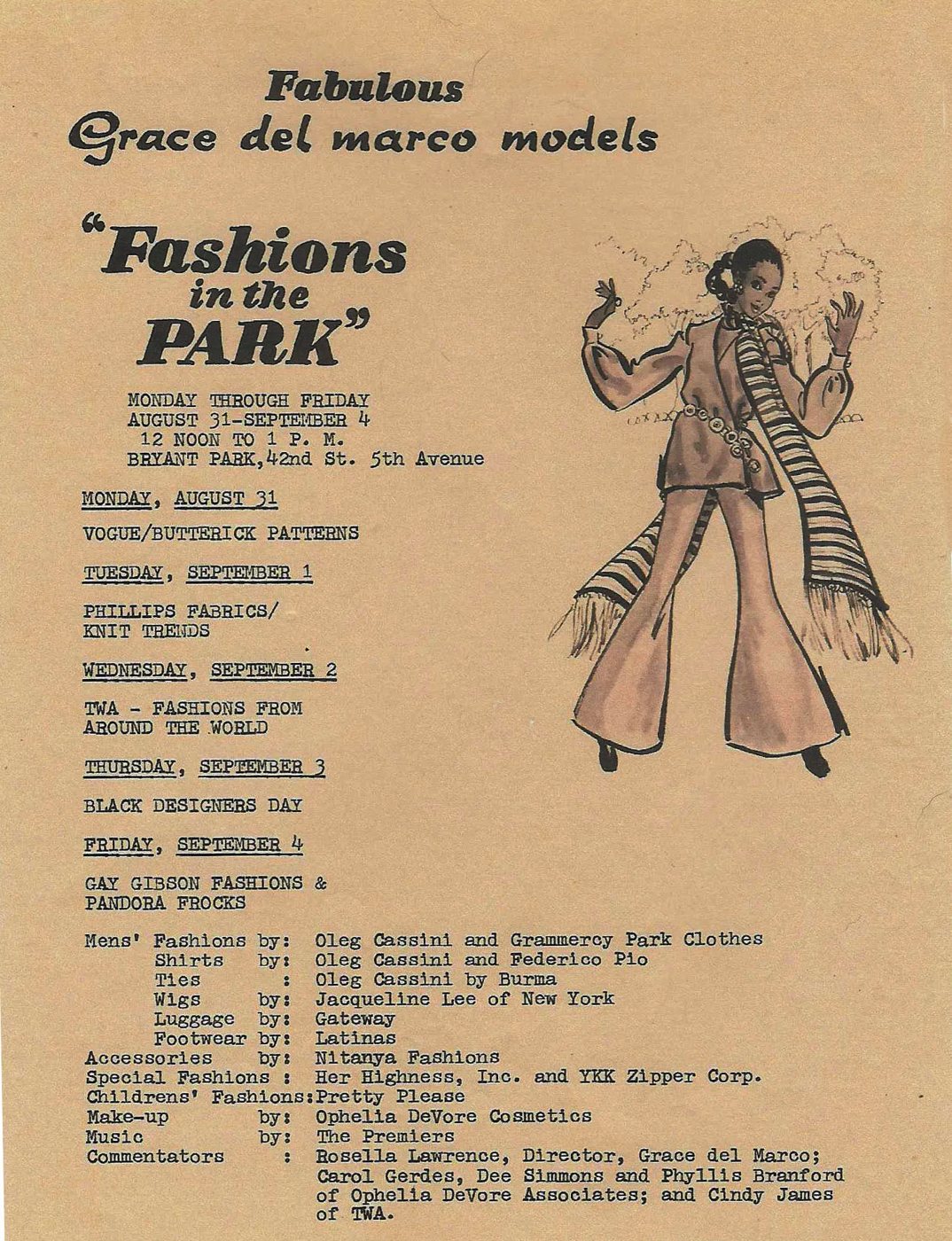
06The 1970 flyer. “Fabulous Grace del marco models — ‘Fashions in the Park,’ Monday through Friday, August 31–September 4, 12 noon to 1 p.m., Bryant Park, 42nd St. 5th Avenue.” Daily schedule, credits and commentators transcribed from the flyer reproduced in Vogue, courtesy of Emory University. The year 1970 is inferred from the weekday/date alignment and Vogue's dating of the flyer as “circa 1970.”
07The Emory holdings. Ophelia DeVore-Mitchell papers, Stuart A. Rose Manuscript, Archives, and Rare Book Library, Emory University — correspondence, professional documents, business records, photographs, scrapbooks, audiovisual materials and printed matter. — Emory News, “Papers of Ophelia DeVore, ‘black is beautiful’ pioneer, come to Emory,” May 2013; collection record at archives.libraries.emory.edu.
08The “one image” figure. MADE CX review of Emory's publicly discoverable digital collections, September 2026: one image of DeVore herself surfaced. This is our count, not an Emory-reported figure; the finding aid describes the physical collection, and Emory may hold digitized material that is not publicly indexed. Vogue independently reports the archive “is not publicly accessible online.”
09Eleanor Lambert and the 1943 press week; the 1993 tents. Lambert's 1943 “press week” at the Plaza Hotel per Vogue (source 01). The CFDA's annual Eleanor Lambert Award and the 1993 arrival of the Bryant Park tents are general industry record; the 1993 date is consistent with Vogue's “24 years before its formal tents.” The “Credited / Untitled” status column is a MADE CX assessment.
10The $0 figure. MADE CX assessment: no public record of any payment, license, credit line or equity to DeVore or her estate for the fashion-week format. Absence in the public record is not proof of absence in private arrangements.
11New York Fashion Week timing. The September 2026 New York shows were under way when Vogue published on 9 September and when this note was written on 12 September 2026.
12The four layers. Preservation, Description, Access and the vacant Commercial (title) layer, and the five roles that hold the sector, are set out in The Archive Map (MADE CX sector position, 2026). The DeVore-papers readout above is a MADE CX application of that framework, not an Emory statement. The claim that prevailing descriptive standards carry no holder-of-record field with legal effect is the framework's own; it describes the standards, not any single institution's practice.
13CPRS instruments. BCID, the Cultural Use License, License-Class Separation and the community reinvestment floor are defined in the MADE CX white paper series — Industrialization of Creativity, Culture as Collateral, and The Culture Exchange.
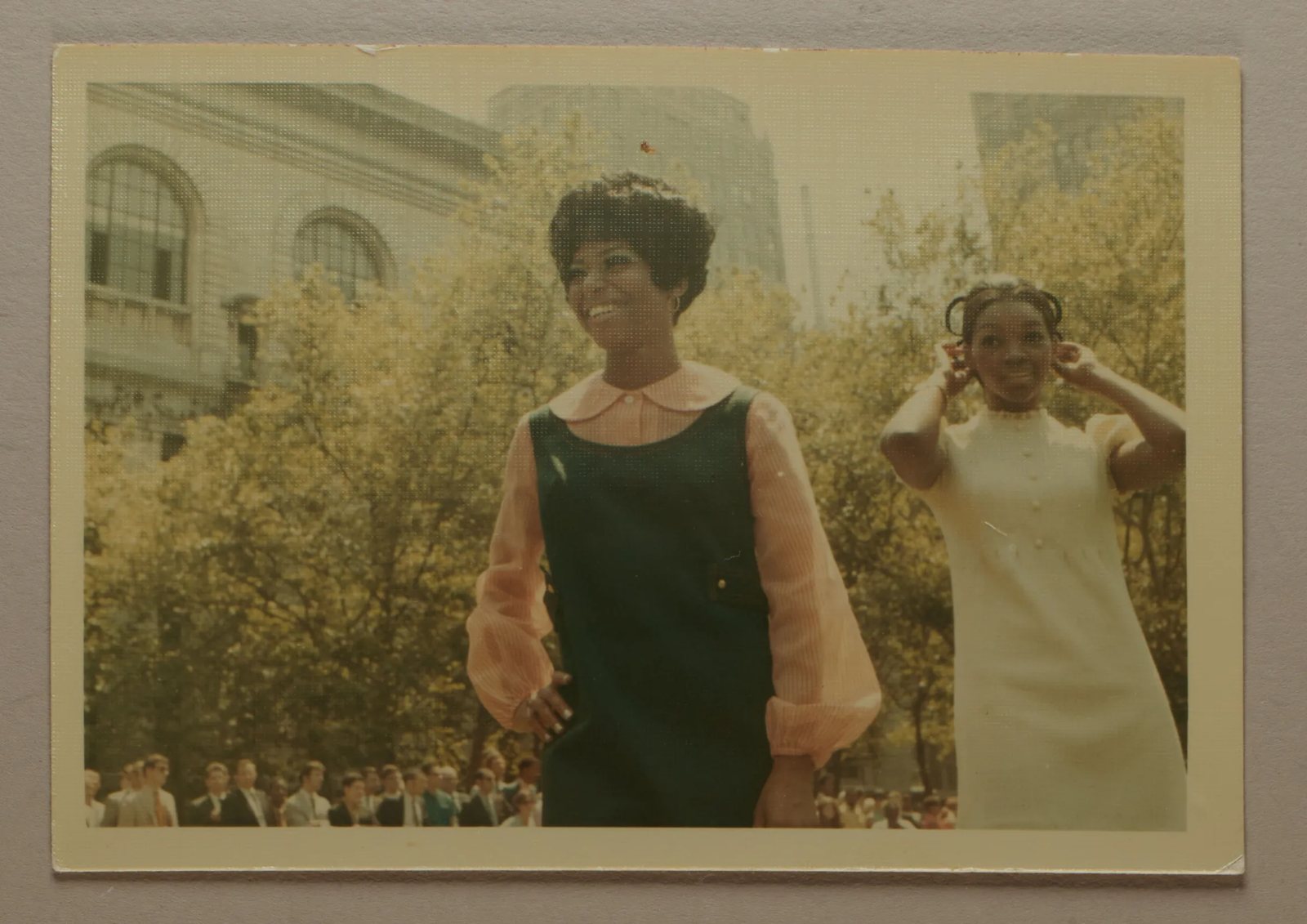
14Images. Hero portrait of Ophelia DeVore, undated, courtesy of the DeVore family; “Fashions in the Park” photograph and 1970 flyer, courtesy of Emory University — all as published by Vogue, 9 September 2026, reproduced here for commentary and analysis.