Culture Market Data · Film & TV, Heritage & Lineage
$DIFFERENTWORLDHillman Has Heirs.
Jasmine Guy’s daughter, Kadeem Hardison’s daughter and Debbie Allen’s son now work inside the show their parents built. Thirty-nine years later, A Different World is passing to a second generation, and no one has recorded who it belongs to.
BCPV
84.40
Tier
4 · Landmark
Modeled TCPMV
$25.8M
Years in market
39
AI Exposure
$52M–$129M
Community Return
$0
Whitley & Dwayne · NBC, 1987–93
On September 24, 2026, exactly 39 years after its NBC premiere, A Different World came back on Netflix.
The credited creator was nowhere near it. The show succeeded anyway, because what audiences wanted back was never one
man's production. It was Hillman: a place, a set of characters and a culture that belonged to the people who made it
and the people who watched it.
This report does three things. It names the film and TV market failure that A Different World survived: the
industry ties a property's value to its originator and has no tool for separating the two when the originator
becomes a liability. It puts a CPRS™ number on the cultural property underneath the library and the revival. And
it makes the case to The Carsey-Werner Company and Netflix that the revival is
missing one piece: a public record of the culture itself, with its lineage, its stewards and a return that routes
back to the community it came from.
01 — The Return
Same campus, new class, 39 years to the day
Netflix's A Different World is a single-camera, ten-episode sequel produced by Honey Chile Entertainment,
Undisputed Cinema and The Carsey-Werner Company. Felicia Pride created the series and runs it.
Debbie Allen, who turned the original into a landmark after its first season, is an executive
producer and directed the premiere, alongside Reggie Rock Bythewood, Gina Prince-Bythewood, Mandy Summers and Carsey-Werner
co-founder Tom Werner. Brandy sings the theme. The premise is lineage itself: Deborah Wayne, youngest
child of Dwayne Wayne and Whitley Gilbert-Wayne, starts her freshman year at Hillman College and finds her parents'
shadow hard to escape.
Property RecordPublic sources · 11/09/26
Credited creator Original series 1987–93: “Created by Bill Cosby.” Revival credit: “Based on A Different World by Bill Cosby.” Also co-writer of the original theme with Stu Gardner and Dawnn Lewis
Bill Cosby Credit retained · no revival role reported
Library & distribution Founded 1981 by Marcy Carsey and Tom Werner; distribution rights reverted to the company after the 2005 DVD licensee was acquired
The Carsey-Werner Company Rights holder
Revival platform Pilot ordered March 28, 2025; premiered September 24, 2026; renewed October 2, 2026
Netflix 10 episodes · Season 2 ordered
Culture stewards Allen ran the original from Season 2 (1988–93); Pride created and runs the revival
Debbie Allen · Felicia Pride Executive producers
Original library Six seasons on NBC; seasons 1–6 added to Netflix February 7, 2025; also on Prime Video via FilmRise
144 episodes Streaming
Debut views
4.2M
First 4 days · No. 4 global
Week 2 hours
27.9M
5.1M views · No. 3 global
Countries
15
Top 10 at debut
Renewed
8 days
After premiere
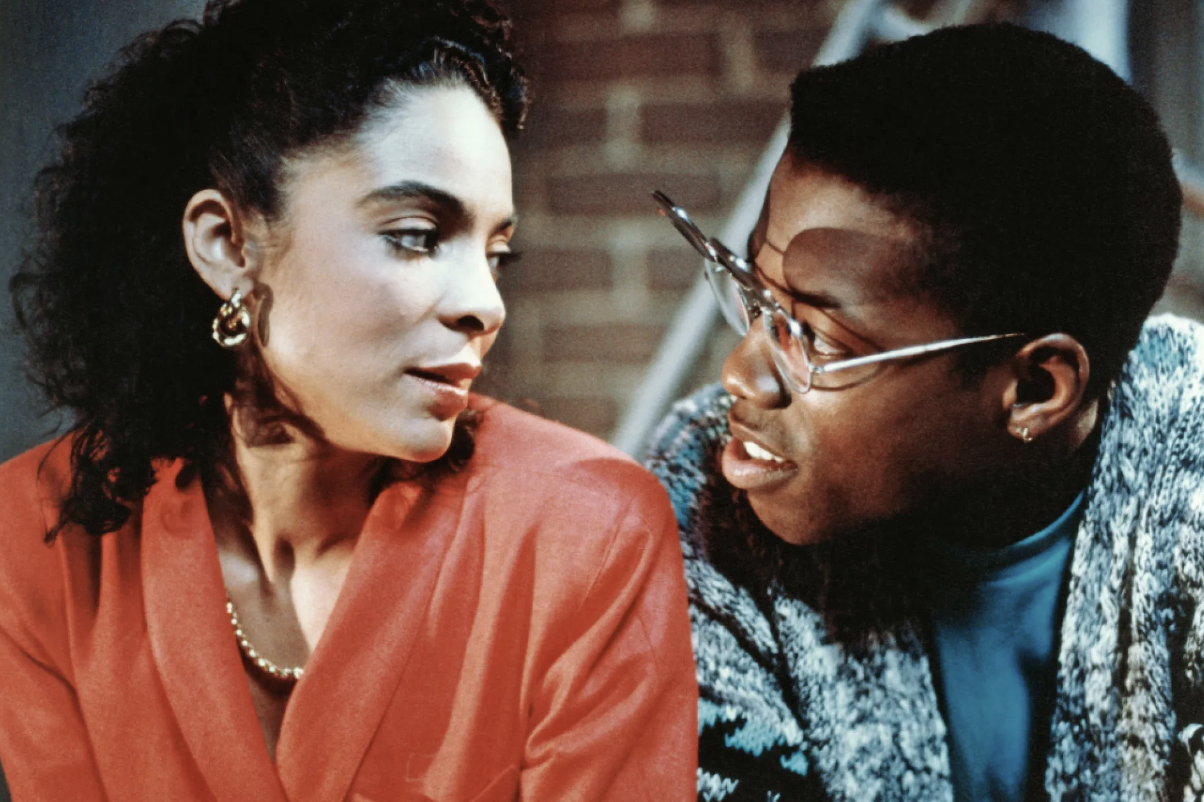
Whitley and Dwayne, 2026. Jasmine Guy and Kadeem Hardison return as special guest stars. Dwayne is now Hillman's president, and the flip-up shades came back with him.
Critics agreed. Rotten Tomatoes reports 82% approval and Metacritic a 72. Netflix ordered a second season eight days
after launch. The demand Debbie Allen measured in 2012, when her post about a reboot drew more than a million
reactions, turned out to be real.
02 — The Proof
The sitcom that changed where Black America went to college
The Museum of Broadcast Communications calls A Different World the first series to immerse an American
audience in student life at a historically Black college. It began as a Cosby Show spin-off and drew harsh
reviews despite instant ratings. After Season 1, the producers brought in Debbie Allen, a Howard University graduate, to rebuild
it. She sent the writers to Atlanta every spring to meet students and faculty at Morehouse, Spelman and Clark Atlanta.
Aretha Franklin took over the theme. The show began writing about unplanned pregnancy, date rape, racial
discrimination, HIV/AIDS and the 1992 Los Angeles uprising. The Hollywood Reporter said it went “from a bland Cosby spin-off into a lively, socially
responsible, ensemble situation comedy.”
Season 1 1987–88 · Rank 2
25.0
Season 2 1988–89 · Rank 3 · Allen era
23.0
Season 3 1989–90 · Rank 4
21.1
Season 4 1990–91 · Rank 4
17.5
Season 5 1991–92 · Rank 17
15.2
Season 6 1992–93 · Rank 71
9.6
Average Nielsen household rating by season, with season rank. Four straight top-4 seasons; among Black viewers the show ranked first or second for most of its run.
Behavior change. HBCU enrollment rose about 24% during the original run, 1987 to 1993, and alumni
regularly name the show as a reason they chose a Black college. Few television properties can point to a
measurable change in where a generation went to school.
A talent pipeline. The MBC credits the series with opening the industry to unprecedented numbers of young
Black actors, writers, producers and directors: a Black woman as producer-director, another as head writer
(Susan Fales), and people of color throughout the creative leadership.
A durable brand. Hillman's motto, Deus Nondum Te Confecit (God has not yet finished you), its
maroon and white, Gilbert Hall and The Pit outlived the show by three decades in fan apparel, memes and homecoming
culture, almost none of it licensed.
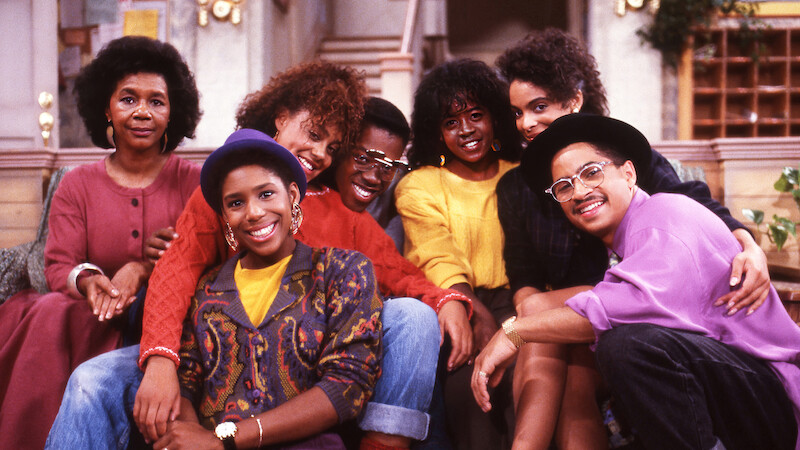
The original NBC ensemble, early seasons. The fashion, slang and campus life on this staircase became a template for how a generation pictured college.
03 — The Market Failure
Film and TV prices a property through its creator. It has no tool for when the creator falls.
A television property's value is papered through a chain of contracts: a created-by credit, a profit
participation, a production company, a distributor and a network. The chain treats the originator as the source of
the asset. When the originator becomes a reputational liability, the industry has one response: remove the
originator. Because nothing separates the culture from the person, the asset often goes with him.
The parent show is the documented case. In November 2014, as the allegations against Bill Cosby spread, TV Land
pulled The Cosby Show reruns. After his 2018 conviction, Bounce TV and Centric pulled Cosby reruns too.
The Pennsylvania Supreme Court vacated that conviction in 2021, but the library had already been quarantined. A
catalog that shaped Black family television went dark on the networks built for its audience, and the cast, writers
and viewers lost access to a culture they had co-created.
Credit-and-contract model
Value tied to the originator
OriginatorCreated-by credit + participation
Single point of failure
Rights holderLibrary & distribution
Carries the risk
Culture stewardsProducers, cast, writers
Work-for-hire
Lineage & communityHeirs, HBCUs, audience
Unrecorded · $0
CPRS™ ledger model
Value recorded as the culture
OriginatorCredit recorded as fact
Severable
CustodianCarsey-Werner, on the ledger
Titled
Culture MakersStewards & lineage, every registered license
80% / 16%
Community ReturnAllocated by the CX Foundation
4%
The 80/16/4 split (Culture Maker / platform / Community Return) applies to licenses recorded on the MADE CX ledger. Allocation among stewards, custodian and lineage is set at registration.
A Different World came through intact for two structural reasons. Carsey-Werner held the library and
distribution itself, so no network could quarantine it. And the culture never really lived with the credited creator.
It lived with Debbie Allen, the cast, the writers' room that went to Atlanta every spring, and the HBCU communities the
show drew from. Even so, the cost of having no record shows up in the timeline:
1993
Series finale. 144 episodes. Syndication follows.
2005–06
Season 1 on DVD only. A Season 2 release is announced for May, July and September 2006 and never ships. Seasons 2–6, the Allen years that made the show a landmark, never come out on disc.
2006
Hillman College Reunion. Nick at Nite runs a marathon; seven cast members film vignettes.
2012
Allen asks for a reboot. More than a million people react across Facebook, Twitter and blogs. Demand is measured, public and unmet.
2014–18
The parent library is quarantined. TV Land, then Bounce TV and Centric, pull Cosby reruns.
2024–25
Netflix moves. Deadline reports the sequel in August 2024; the original library reaches Netflix in February 2025; a pilot is ordered in March 2025.
2026
Premiere, 39 years to the day. No. 3 globally in week two, renewed in eight days. Fourteen years after the public demand signal.
The reasons for each delay are not public, and COVID-19 held up production. This report doesn't assign the gap to
any party. The point is structural: for fourteen years, the clearest demand signal in Black television had no
instrument to attach to. No registry recorded Hillman as a property, priced the unmet demand or showed a buyer
that the culture could be licensed cleanly, apart from the credit.
The industry's only tool for originator risk is to remove the originator. CPRS™ records the culture, so the
culture doesn't leave with him.
04 — The Lineage
The asset has heirs, on screen and off
Most television libraries decay. A show runs, syndicates, and its audience ages out. A Different World
does something rarer: it renews itself through lineage. The 1987 audience is now the parent generation. The revival is
written about their children. Behind the camera, the original cast's own children and family are joining the property.
Each generation re-enters the same cultural asset, and each entry extends its life cycle by another generation of demand.
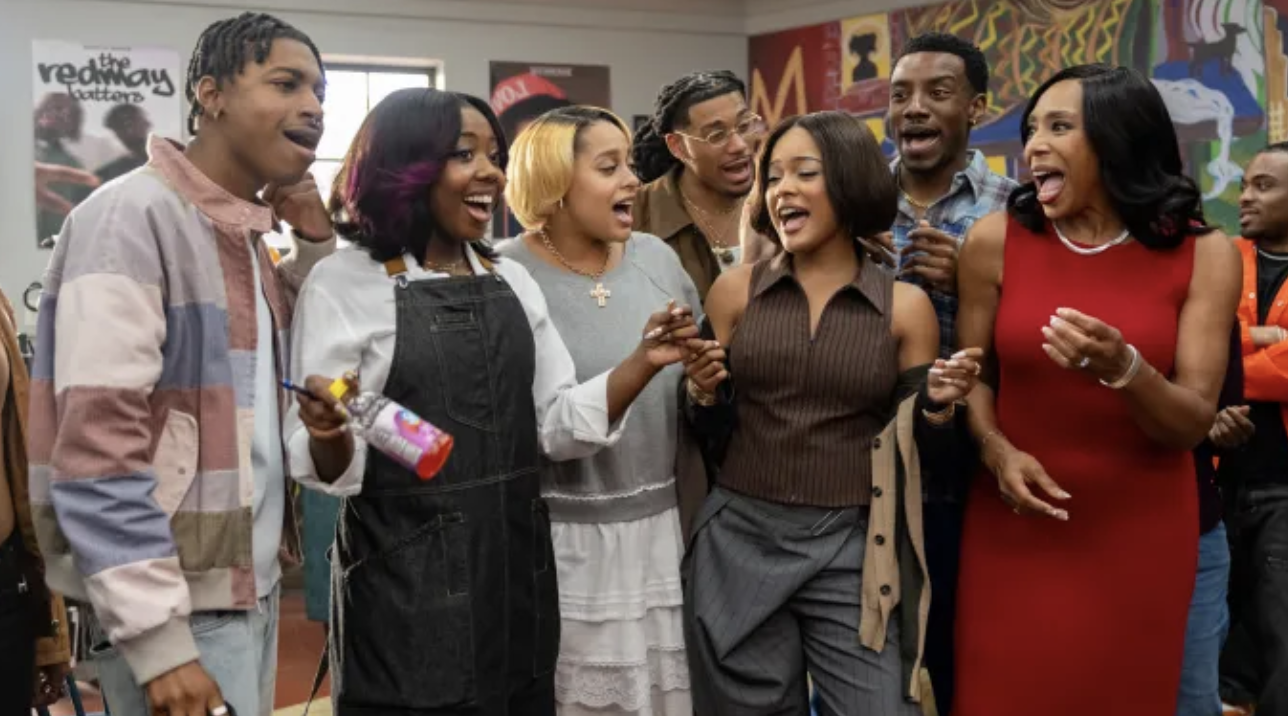
The 2026 Hillman class on Netflix. Several of the new characters are legacies of the originals.
On-screen lineage: the story's own heirs
2026 character
Actor
Legacy of
Deborah WayneLead · freshman
Maleah Joi Moon
Youngest child of Dwayne Wayne and Whitley Gilbert-Wayne. Her dorm carries her mother's maiden name; her father is Hillman's president.
Shaquille JohnsonFootball recruit
Cornell Young IV
Son of Ron Johnson (Darryl M. Bell).
Dr. Brooklyn BoyerFirst-year professor
Raven Goodwin
Daughter of Dr. Kimberly Reese Boyer (Charnele Brown); a Hillman alumna.
Nellie GainesRuns The Pit
Famecia Ward
Granddaughter of Mr. Vernon Gaines (Lou Myers).
Ellington KendallTutor
Vincent Jamal Hooper
A Kendall, linked to Denise Kendall (formerly Huxtable). The Cosby-universe lineage continues without the credited creator.
Bloodline lineage: the cast's own heirs
Family member
Relation
2026 role
Norman Nixon Jr.
Son of Debbie Allen
Professor Baptiste
Imani Guy Duckette
Daughter of Jasmine Guy
Teedra
Sophia Hardison
Daughter of Kadeem Hardison
Episode 10 gala
Rainbow Sun Francks
Brother of Cree Summer
Larry, Amir's parole officer
Alijah Kai
Daughter of Tichina Arnold, who plays her on-screen mother
Rashida Duvall (main cast)
Returning originals
11
Special guest + recurring
On-screen legacies
5
Children & grandchildren
Real-life family
5
Ties to cast & Allen
Generations
2+
Audience & talent
That's the dynamic CPRS™ is built to measure. A production slate prices a season. A library prices past episodes.
Neither has a field for inheritance: the fact that Jasmine Guy's daughter, Kadeem Hardison's daughter
and Debbie Allen's son now work inside the same cultural property their parents built, and that the audience's children
are watching. CPRS™ carries this in the Heritage & Lineage dimension and in Cultural Influence, and it's why the
revival behaves less like a reboot and more like a second issuance of the same asset.
Why lineage compounds
Each generation resets the decay curve
A conventional TV asset loses its audience as that audience ages. A lineage asset gains a new cohort each time
the story passes to an heir: the 1987 viewers become co-viewers with their children, legacy characters give the new
audience a reason to start the original, and family casting adds an off-screen story that press and social media
carry for free. The 2025 library placement followed by the 2026 revival is that loop running once. A Season 2 order
means it will run again.
05 — The Valuation
BCPV 84.40 — Tier 4 Landmark
Scored across the five CPRS™ dimensions, $DIFFERENTWORLD returns a composite of 84.40. In the Culture Market Data
series that places it below $JUST2OFUS (86.80), $REESE (90.30) and $MJB (90.45). This is a soft pass. It uses public
reference sources, trade and press reporting, Netflix Top 10 data and CPRS™ modeling, not license fees,
participation statements or settlement data. It carries a confidence factor of 0.66.
CIS 92. Few sitcoms changed behavior. This one is linked to a roughly 24% rise in HBCU enrollment over
its run and is still cited by alumni as the reason they enrolled. It was the first series to put HBCU life in front of
a national audience, it opened doors for a generation of Black writers and directors, and a 2012 post about rebooting it
drew more than a million reactions. The revival hit the Top 10 in 15 countries. It's held below the mid-90s because,
unlike a song, the property's influence spread mostly through a domestic audience, and much of it now circulates as
unattributed style and memes.
CCI 78. Conversion is strong but mostly measured in attention, not settled transactions. The original
ranked in the top four for four straight seasons with household ratings from 25.0 to 17.5. The revival drew 4.2 million
views in four days, then 5.1 million views and 27.9 million hours in week two. It's held down because no license fees,
syndication revenue or participation statements are public, and because ratings and views show demand, not sell-through.
Every modeled revenue line below carries a 30% realization discount.
LIP 86, the flagged dimension. Whitley Gilbert and Dwayne Wayne are among the most recognizable
couples in Black television. Her Southern-belle persona and his flip-up sunglasses still sell without explanation, and both
actors carried them across 39 years. The likeness is split among characters (held by the custodian), actors (held by
the cast) and a credited creator whose name lowers commercial appeal. That split holds the score down. Aretha Franklin's
theme vocal from Seasons 2 to 5 is posthumous voice, which raises both the score and the D3 flag.
CUV 74. Commercial use is documented: NBC syndication, the 2006 Nick at Nite reunion, a Season 1 DVD,
streaming on Prime Video and Netflix, and now a licensed sequel. It's the lowest-scoring dimension for a reason. Five of
six seasons never reached home video, the parent library was pulled from cable, and the most visible commercial
surface, Hillman apparel, circulates largely unlicensed. Documented uncompensated use lifts CUV as a demand signal, but a
fragmented title keeps it in the mid-70s.
HLM 90. The lineage runs deep: a fictional institution founded in 1881 and modeled on real HBCUs,
campus exteriors filmed at Spelman and Clark Atlanta, a Howard alumna as the creative steward, and now two generations of
the cast's own families working inside the property. It stops short of the mid-90s because the custody chain breaks at
the originator. The credited creator is out of the story, and the culture's real custodians have never been recorded as
such.
Fingerprint note
Heritage-heavy with a hollow commercial title: CIS and HLM at 90+, CUV in the 70s
This is the shape of a severed-originator property. Influence and lineage are near the top of the series, while
commercial usage is held down by a broken chain, not by weak demand. It's closest in kind to $JUST2OFUS (86.80),
whose influence also travels further than its credits. The difference is that $DIFFERENTWORLD's gap is structural:
recording the stewards and the lineage on a ledger would lift CUV without changing the culture. Both briefs carry
HLM in the 100-scale raw form, so the composites compare point for point.
Commerce base
$8.15M
12-month, modeled, net
Blended CDC
3.17×
Music + Ent. / fashion / tech
Modeled TCPMV
$25.8M
$18.1M – $35.6M
Unrecorded surface
$5.25M
20% of TCPMV
TCPMV applies a blended Cultural Demand Coefficient to a modeled commerce base of about $8.15 million: the commerce the
$DIFFERENTWORLD property moves over the 12 months from November 2025 to October 2026. Music & Entertainment at
3.0× carries the library, the revival's underlying-property share, the theme and live appearances. Fashion at 3.5×
carries Hillman apparel, and Tech / AI Data at 4.5× carries the platform layer. Weighted, that's
3.17×, or about $25.8 million.
06 — The Stack
Where $DIFFERENTWORLD's value moves, and who holds it
Each line is a modeled estimate of 12-month commerce attributable to the property, before the CDC is applied, shown net
of the 30% realization discount. Lines held outside the base are shown so readers can see where the lost value sits.
Line
What the property moves
Base
CDC
TCPMV
Library144 episodes · streaming
Netflix since February 2025, Prime Video via FilmRise, catch-up viewing driven by the revival.
$2.10M
3.0×
$6.30M
RevivalUnderlying-property share
The share of Netflix Season 1 attributable to Hillman, the title and the legacy characters. Netflix doesn't publish budgets or fees.
$4.20M
3.0×
$12.60M
MusicTheme · publishing
The original theme (Gardner, Cosby, Lewis) and Brandy's 2026 rendition.
$0.30M
3.0×
$0.90M
Live & eventsPremieres · reunions
Cast appearances, premiere events and HBCU homecoming tie-ins.
$0.25M
3.0×
$0.75M
Hillman apparelFan merchandise
Hillman sweatshirts, tees and Gilbert Hall gear sold across marketplaces. Mostly unlicensed.
$0.60M
3.5×
$2.10M
PlatformsUGC · clips · memes
Whitley and Dwayne clips, reaction edits and fashion throwbacks. Unattributed.
$0.70M
4.5×
$3.15M
HBCU haloEnrollment effect
The enrollment and alumni-giving value the show helped generate. Real, but never recorded or routed back.
—
—
—
Home videoSeasons 2–6
Announced three times in 2006 and never released.
$0
—
$0
Creator participationOriginal-era terms
Not public. Not modeled.
—
—
—
TOTAL
Modeled commerce · blended CDC 3.17×
$8.15M
3.17×
$25.80M
Layer 01 · Credited Originator
Bill Cosby
Holds the created-by credit and a “based on” credit on the revival, plus a co-writing credit on the
original theme. Public reporting describes no creative or financial role for him in the revival. The terms of his
original creator participation have never been published.
Recorded as fact · participation undisclosed
Layer 02 · Custodian
The Carsey-Werner Company
Holds the 144-episode library and distribution rights, and co-produces the revival through Tom Werner. Its
independent library ownership is why this property survived when the parent show's reruns were pulled. It's the
necessary party to any complete record.
Licenses the original library and commissioned the revival, renewed for Season 2. Netflix now holds the
property's most important commercial surface: the place a new generation meets Hillman.
Captured value: subscription engagement
Layer 04 · Culture Stewards
Debbie Allen, Felicia Pride & the cast
The people who made Hillman a culture: Allen's rebuild, the writers' room, Jasmine Guy, Kadeem Hardison and the
ensemble, and now Pride's revival. They're paid as talent and producers. None holds a recorded interest in the
culture they created or carried for 39 years.
Captured value: fees · no recorded equity
Layer 05 · Community
HBCUs, alumni & the families who watched
Spelman, Clark Atlanta, Morehouse and Howard supplied the setting, the stories and the students. A generation
enrolled because of the show. That's the cultural input and the clearest social return in the stack. Nothing routes
back to it.
Captured value: $0 · Community Return unrecorded
Layer 06 · Derivative ▲
Likeness, Voice & AI
Two iconic character likenesses, 144 episodes of performance data, a recognizable campus and a posthumous Aretha
Franklin vocal. AI and synthetic exposure is modeled at 2–5× TCPMV, or $51.6M–$129M.
A synthetic “Hillman” episode or a Whitley-voiced ad needs no footage and today faces no clear claimant.
Captured value: unstructured, unpriced
D3 ▲ Critical — AI & synthetic exposure
The revival made Hillman famous again. It didn't make it registered.
Every hit season raises the stakes. The more recognizable Whitley, Dwayne and Hillman become to a new generation,
the more valuable they are to generative systems, and the more a synthetic market reaches for them first. Today the
title is split among a custodian (characters and footage), individual actors (their own likenesses) and an estate
(Franklin's voice), with no single record to enforce against. Register $DIFFERENTWORLD.AI before
Season 2 marketing, not after the first synthetic clip. Registration doesn't stop replication. It gives the holders
something to enforce with.
07 — The Restoration
What CPRS™ gives Carsey-Werner and Netflix
This brief is addressed to the rights holder and the platform, not against them. Carsey-Werner and Netflix already did
the hard part. They brought the culture back without its credited creator, with its original steward in charge and its
own heirs on screen. CPRS™ is the missing piece that makes the restoration permanent and puts the value of the
culture on the record, separate from any one person's production or distribution.
01 · De-risk
Separate the culture from the credit
A CPRS™ record lists the credited originator as a historical fact and the culture as its own property, with its
stewards, lineage and custodian named. The next time an originator becomes a liability, the asset stays on the air.
That protection applies across the Carsey-Werner library.
Adds: an originator-risk instrument
02 · Recognize
Record the stewards and the heirs
Debbie Allen rebuilt this property. Jasmine Guy and Kadeem Hardison carried it for 39 years. Their children now work
inside it. A ledger can recognize that as a recorded interest in the culture, not just a fee for one season.
Adds: lineage on the record
03 · Return
Route value back to the HBCUs
On a modeled $25.8M TCPMV, a 4% Community Return is about $1.0M, allocated by the CX Foundation to
Health & Wellness, Culture Alignment, Entrepreneurship and Sustainable Communities. Hillman's Season 1 finale is a
budget crisis. A real return to real HBCUs closes that loop in the audience's world.
Adds: a story the audience can join
04 · License
Turn Hillman apparel into a licensed line
The demand for Hillman gear already exists and mostly runs unlicensed. A registered $HILLMAN record gives the
custodian a clean title to license against, priced from a public benchmark, with every use recorded on the ledger.
Adds: a recorded commercial surface
How $DIFFERENTWORLD would register
Following the series convention, the property registers as a parent with severable records. Carsey-Werner sits at the
table as custodian. Netflix participates as the revival licensee. The cast hold their own likeness records. The AI entry
is the priority.
Community Return Current state, unregistered · 4% at modeled TCPMV ≈ $1.0M
$0 CPRS™ attribution
Execution constraint — primary gate
The chain of title behind the credit isn't public
A complete record needs the documents behind the credits: Carsey-Werner's library ownership and distribution terms,
the original creator agreement and any surviving participation, the underlying-rights terms of the Netflix revival,
theme publishing splits, and the cast's likeness terms. None are public. Those documents, and Carsey-Werner's consent
as custodian, are the first fields a Day-0 registration would capture and the first things to review before any
figure here is acted on.
The production can be revived. The distribution can be licensed. The culture is the asset, and it has never had a record.
Carsey-Werner and Netflix proved that a heritage property can be separated from a compromised originator and come back
stronger. Debbie Allen proved that the culture always lived with its stewards. The cast's children proved it has heirs.
What's missing is the instrument that makes all of that legible to a market.
Markets recognize asset classes when someone builds the registry, publishes the method and makes the first entries.
MADE CX built the financial infrastructure for $CULTURE to function as property. $DIFFERENTWORLD is the clearest case
yet that the story is the asset.
Methodology & disclosure
Soft pass. Modeled from public reference sources and reporting, not license fees, participation
statements or settlement data. Series facts, cast, credits (“Created by Bill Cosby”; “Based on A Different
World by Bill Cosby”), theme authorship, ratings by season, the HBCU enrollment figure, DVD history, the 2006 reunion
and the 2012 reboot post are from the Wikipedia entries for A Different World (1987) and A Different
World (2026). The Allen-era account, the Atlanta writers' trips and The Hollywood Reporter quote are from the
Museum of Broadcast Communications Encyclopedia of Television. Carsey-Werner's history and library are from its
Wikipedia entry. On-screen legacy characters are from PEOPLE (Angela Andaloro, Sept 24, 2026). Real-life family casting
is from Because of Them We Can and Yahoo Entertainment. Netflix figures are from What's on Netflix (Oct 2, 2026) and
MovieWeb (Oct 7, 2026). Rerun removals are from TV Land (Nov 2014) and Bounce TV / Centric (April 2018) reporting.
Confidence factor 0.66. TCPMV is presented as a band ($18.1M–$35.6M), not a point.
Originator statements. Statements about Bill Cosby are limited to public credits and to reporting that
he has no creative role in the revival. Reports that he receives no revival royalties, or that he signed off on the
characters, come from secondary and social-video sources and weren't independently verified for this pass. They aren't
relied on for any figure. His original creator participation terms aren't public and aren't modeled. His 2018 conviction
was vacated by the Pennsylvania Supreme Court in 2021.
Window, discounts and routing. The commerce base is a MADE CX model of attributable commerce over a
12-month window (Nov 2025–Oct 2026), presented as an estimate. Every line carries an explicit 30% realization discount.
The revival line is the share of Season 1 commerce attributable to the underlying property, estimated from engagement;
Netflix doesn't publish budgets or license fees. Library, revival, music and live lines are routed Music &
Entertainment (3.0×); apparel Fashion (3.5×); the platform line Tech / AI Data (4.5×). Per series convention, sector
multipliers are applied directly to the commerce base. HLM is carried as a 0–100 raw score at 10% weight inside BCPV.
The HBCU halo, unreleased home video and creator participation are held outside the base.
Tier placement. Tier is placed from the modeled TCPMV band (Tier 4 · Landmark, $2M+). HLM 90 sits in
the heritage range typical of Tier 4 records, so this is both a band and a heritage placement.
Property valuation, not library value. TCPMV values the $DIFFERENTWORLD cultural property, meaning the
commerce the culture moves across the stack. It isn't an appraisal of the library, the revival, Carsey-Werner or Netflix,
and it isn't a price, a license fee or investment advice.
Report DFW-CX-2611-036. Culture Market Data · MADE CX · November 9, 2026. Soft valuation, not an
appraisal, not a registered record, not investment advice.
For The Carsey-Werner Company · Netflix
You restored the show. Now restore the record.
MADE CX registers, scores and titles cultural property, then records every use on a public ledger with an 80/16/4 split
that keeps Culture Makers participating and routes 4% back to the community. We'd like to make $DIFFERENTWORLD the first
television property co-registered by its custodian, its platform and its stewards, before Season 2.
About this analysis. This valuation is an editorial estimate produced under the Cultural Property Rights Standard (CPRS), a proprietary methodology developed by MADE CX. It is not an appraisal, a fairness opinion, an audit, or a certified valuation, and it has not been prepared under USPAP or any other appraisal standard. It is not suitable for financial reporting, lending, tax, insurance, or transactional purposes.
Sources and independence. Figures derive from publicly available information and modeled assumptions as of the publication date. No person or entity named has reviewed, approved, verified, commissioned, or been compensated in connection with this analysis.
Editorial designation. A dollar-sign designation (e.g. $CULTURE) is editorial shorthand identifying the subject of this analysis. It is not a security, digital asset, token, fund, share, or instrument of any kind, and nothing here offers one.
No affiliation; no offer; no advice. Names, marks, and images appear for reporting, commentary, and analysis, and do not imply affiliation with, sponsorship by, or endorsement of MADE CX. Nothing here is an offer to sell or a solicitation of an offer to buy any security or interest, or investment, legal, accounting, or tax advice.
Forward-looking statements. Statements about future markets, values, or outcomes are modeled projections resting on significant assumptions. Actual results will differ.